
 Elizabeth123
In Nigeria’s multilingual market, professional translation services like Translation Africa are essential for effective marketing campaigns, bridging linguistic divides and adapting content to languages such as Hausa, Yoruba, and Igbo. These services guarantee accurate language delivery, incorporate cultural nuances to prevent misinterpretations, and boost audience engagement while building brand trust. Strategies for localization and successful case studies demonstrate measurable benefits. Further exploration of this topic reveals tools and challenges for optimized outcomes.
Quick Summaries
- Translation services in Nigeria adapt marketing content to local languages like Hausa and Yoruba, ensuring messages resonate with diverse audiences.
- Accurate delivery by services minimizes errors and maintains original intent, building trust in multilingual marketing campaigns.
- Cultural adaptation strategies help incorporate Nigerian idioms and traditions, enhancing engagement and preventing misinterpretations.
- Case studies demonstrate that effective translations, such as Yoruba campaigns, can increase sales by up to 40% in targeted regions.
- Select providers with expertise in Nigerian nuances and tools like CAT systems for reliable, high-quality marketing translations.
The Importance of Translation in Nigerian Marketing

Translation plays an essential role in Nigerian marketing by bridging linguistic divides in a multilingual society. With over 500 languages spoken across the country, translation guarantees marketing messages reach diverse ethnic groups, fostering effective communication and cultural resonance. In a nation where English, Hausa, Yoruba, and Igbo dominate, untranslated campaigns often fail to engage non-English speakers, resulting in limited audience penetration and weakened brand impact. By adapting content to local languages, marketers can build trust and inclusivity, essential for handling Nigeria’s complex social landscape. This practice amplifies reach in rural and urban areas alike, preventing misinterpretations that could undermine campaigns. Ultimately, translation empowers businesses to tap into Nigeria’s rich linguistic diversity, enhancing overall marketing efficacy without relying on external services.
Benefits of Using Professional Translation Services

Professional translation services in Nigeria provide key benefits for marketing strategies. Accurate language delivery guarantees that messages are conveyed precisely without misinterpretations. Additionally, cultural adaptation advantages and expanded market access enable businesses to connect with diverse audiences more effectively.
Accurate Language Delivery
Accurate language delivery is essential for effective marketing in Nigeria, where linguistic diversity can greatly impact audience engagement. Professional translation services play a pivotal role by ensuring messages are conveyed with precision, minimizing errors that could distort intent or erode trust. This precision helps businesses connect more effectively with diverse audiences, boosting campaign success through clear, reliable communication.
- Precision in Terminology: Uses industry-specific language accurately to maintain professional standards.
- Error-Free Translations: Eliminates grammatical and syntactical mistakes for polished content.
- Intent Preservation: Retains the original message’s core meaning without alteration.
- Enhanced Clarity: Improves readability, making information accessible to all demographics.
- Increased Credibility: Builds brand reliability by avoiding misinterpretations that could harm reputation.
Cultural Adaptation Advantages
Cultural adaptation in marketing extends beyond literal translation, enabling businesses to tailor content to Nigeria’s rich cultural contexts for greater audience resonance. Professional translation services adeptly handle cultural nuances, such as idioms and traditions, to avoid misinterpretations and foster trust. This guarantees marketing materials resonate deeply, boosting engagement and brand loyalty without alienating audiences. For example, adaptations prevent cultural blunders while enhancing relevance.
| Cultural Element | Potential Pitfall Without Adaptation | Advantage with Adaptation |
|---|---|---|
| Greetings | Offending locals with generic phrases | Uses authentic expressions like “Eku ase” for warmth |
| Symbols | Misinterpreting icons | Aligns with meaningful symbols, e.g., Adire patterns |
| Humor | Jokes falling flat | Incorporates relatable Nigerian wit for laughter |
| Values | Ignoring community norms | Emphasizes respect for family and community bonds |
Ultimately, such strategies amplify campaign effectiveness through precise cultural alignment. (124 words)
Expanded Market Access
Utilizing professional translation services, businesses in Nigeria can overcome language barriers to access broader markets, enabling seamless entry into diverse linguistic regions and enhancing overall reach. This approach not only facilitates global expansion but also guarantees marketing messages resonate effectively across cultures, driving sustainable growth.
- Target new demographics: Reach untapped audiences in multilingual regions like Hausa, Yoruba, and Igbo-speaking areas.
- Boost engagement: Increase customer interaction through accurately translated content, fostering loyalty.
- Enhance competitiveness: Gain an edge over rivals by localizing campaigns for better market penetration.
- Drive sales growth: Expand revenue streams by making products accessible to non-English speakers.
- Strengthen partnerships: Build international alliances through precise communication, opening doors to collaborations. (124 words)
Cultural Adaptation for Effective Campaigns
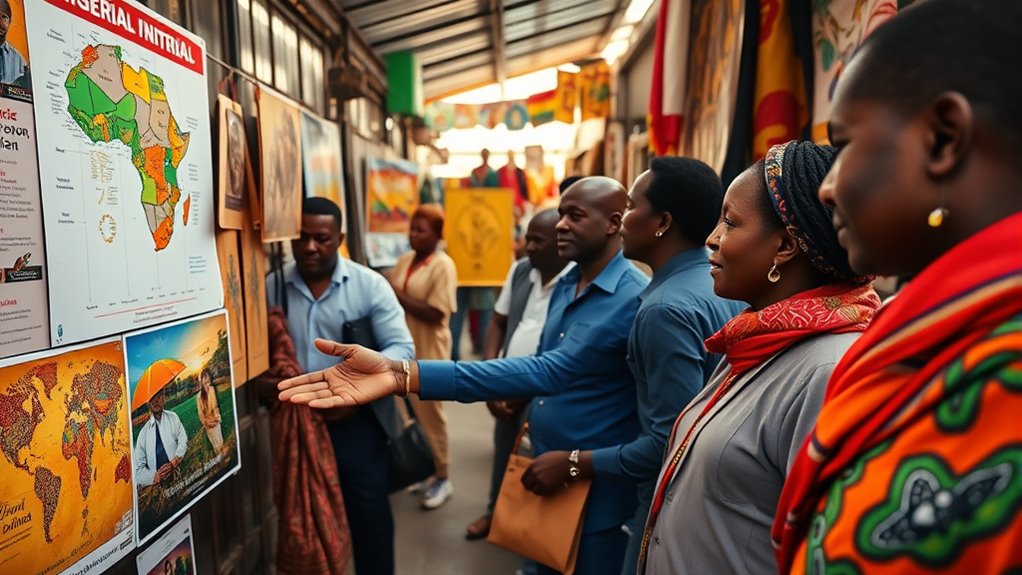
Effective marketing campaigns in Nigeria necessitate cultural adaptation to resonate with local audiences. Cultural nuances integration guarantees that translations reflect regional customs and values, avoiding misinterpretations. Language adaptation strategies further enhance this by tailoring content to idiomatic expressions and contextual relevance.
Cultural Nuances Integration
In Nigeria’s diverse cultural landscape, adapting marketing strategies to local nuances is essential for campaign effectiveness. This process, known as cultural nuances integration, guarantees campaigns resonate deeply with Nigeria’s multifaceted ethnic groups, such as the Yoruba, Igbo, and Hausa, by embedding authentic elements into messaging. It prevents cultural missteps that could alienate audiences and fosters genuine connections, ultimately boosting engagement and brand loyalty.
- Respect ethnic traditions: Tailor campaigns to honor customs like festivals or rites of passage for relevance.
- Incorporate local symbols: Use indigenous art, colors, and motifs to evoke familiarity and trust.
- Avoid cultural taboos: Identify and steer clear of sensitive topics, such as certain religious practices, to maintain respect.
- Engage community values: Align messaging with core societal norms, like family and community solidarity, for emotional impact.
- Test for authenticity: Conduct focus groups to refine campaigns, guaranteeing they reflect real cultural contexts accurately.
Language Adaptation Strategies
Language adaptation strategies form a cornerstone of culturally tailored marketing in Nigeria, where over 500 languages and dialects influence audience perceptions. These strategies go beyond mere translation, incorporating localization to align messaging with local idioms, customs, and social contexts. For instance, marketers must adapt English slogans to resonate in Yoruba, Hausa, or Igbo, ensuring they evoke the intended emotions without cultural missteps. This involves collaborating with native linguists who understand subtle nuances, such as taboos or humor, to avoid alienating consumers. Effective campaigns therefore employ tools like transcreation, which reimagines content for cultural relevance, boosting engagement and trust. In Nigeria’s diverse market, such approaches enhance brand loyalty, drive conversions, and mitigate risks of backlash, ultimately optimizing ROI for global businesses.
Strategies for Localizing Marketing Content
Localizing marketing content for Nigeria requires adapting elements like language, cultural nuances, and visual aesthetics to connect with diverse audiences. This process guarantees campaigns resonate in a multicultural context, enhancing engagement and trust. Effective strategies focus on tailoring content to regional preferences without alienating groups.
- Language Customization: Beyond translation, adapt slang and idioms to suit ethnic groups like Hausa, Igbo, or Yoruba speakers.
- Cultural Integration: Incorporate local traditions, festivals, and values to make messaging relatable and authentic.
- Visual Adaptation: Modify images, colors, and designs to align with Nigerian aesthetics, such as vibrant patterns or modest representations.
- Audience Segmentation: Target specific demographics by considering urban-rural divides and socioeconomic factors.
- Feedback Mechanisms: Test content with local focus groups to refine it based on real-time responses.
Case Studies of Successful Translations in Nigeria
Examining real-world examples, successful translations in Nigeria showcase how tailored adaptations have boosted marketing effectiveness across diverse demographics. For instance, a beverage company’s Yoruba campaign resonated with southern audiences by incorporating local idioms, increasing sales by 40%. Another case involved a tech firm adapting English content into Hausa for northern markets, enhancing user engagement through culturally relevant storytelling.
| Case Study | Key Impact |
|---|---|
| Beverage Campaign | 40% sales increase |
| Tech Firm Localization | 25% higher engagement |
| Fashion Brand Adaptation | Doubled brand affinity |
These examples highlight the power of precise cultural alignment, driving measurable results in Nigeria’s multilingual landscape.
Selecting the Right Translation Provider
Selecting the right translation provider is essential for optimizing marketing strategies in Nigeria’s multilingual market. In a diverse landscape with over 500 languages, choosing a provider with deep cultural and linguistic expertise guarantees messages resonate authentically, boosting engagement and brand loyalty. This decision influences campaign effectiveness, cost efficiency, and overall success.
- Cultural Competence: Providers must understand Nigerian nuances, idioms, and regional dialects to avoid misinterpretations.
- Specialized Experience: Look for firms with proven track records in marketing translations, not just general services.
- Quality Assurance: Guarantee rigorous editing and proofreading processes to maintain accuracy and consistency.
- Technology Integration: Select providers using advanced tools like CAT systems for faster, error-free deliveries.
- Reputation and References: Check client testimonials and case studies to verify reliability and performance metrics.
Overcoming Challenges in Marketing Translations
While selecting a translation provider lays the groundwork, marketers in Nigeria face obstacles such as cultural misalignments and linguistic complexities that can undermine campaign effectiveness. Cultural misalignments often arise from overlooking local traditions or idioms, leading to alienating audiences. To overcome this, marketers should collaborate with native linguists who understand regional nuances, ensuring messages resonate authentically. Linguistic complexities, including diverse dialects like Hausa, Igbo, and Yoruba, demand precise adaptations to maintain intent without distortion. By implementing rigorous review processes and cultural consultations, campaigns can achieve greater accuracy. Additionally, pre-launch testing with target demographics helps identify and rectify potential issues, enhancing overall impact and fostering trust in Nigeria’s multicultural market. This proactive approach safeguards brand integrity and boosts engagement.
Tools and Technologies for Translation Services
In the evolving landscape of translation services, advanced tools and technologies greatly enhance marketing efforts in Nigeria by addressing linguistic and cultural challenges. These innovations enable precise, efficient translations that resonate with diverse audiences, boosting campaign effectiveness while minimizing errors.
- Computer-Assisted Translation (CAT) tools like SDL Trados maintain consistency and terminology across multilingual content.
- AI-powered engines, such as Google Translate API, accelerate translation processes with real-time accuracy.
- Machine learning algorithms adapt marketing materials to regional dialects and cultural nuances in Nigeria.
- Cloud-based platforms, including MemoQ, support seamless collaboration among translators and marketers.
- Integration software links translation tools with marketing automation systems for streamlined workflows.
Measuring Success in Translated Marketing Efforts
Determining the success of translated marketing efforts in Nigeria requires targeted metrics that evaluate audience engagement and return on investment. Businesses analyze key performance indicators to assess how well localized campaigns resonate with diverse audiences. For instance, tracking engagement rates reveals interaction levels, while conversion rates indicate action-driven results. Return on investment (ROI) quantifies financial gains against costs, ensuring cost-effectiveness in multilingual strategies.
| Metric | Description |
|---|---|
| Engagement Rate | Measures interactions like shares and comments to gauge audience interest in translated content. |
| Conversion Rate | Tracks the percentage of users who complete desired actions, such as purchases, post-translation. |
| ROI | Calculates net profit from marketing spend, highlighting the financial viability of efforts. |
| Audience Reach | Assesses the number of people exposed to campaigns, ensuring broader market penetration in Nigeria. |
Frequently Asked Questions
How Much Do Translation Services Cost?
The cost of translation services varies widely based on factors such as language pairs, word count, complexity, and provider expertise. Rates often range from $0.05 to $0.25 per word, with additional charges for rush jobs or specialized fields like marketing or legal content.
What Is the Typical Turnaround Time?
The typical turnaround time for translation services varies based on project complexity, volume, and language pairs involved. For standard assignments, it often ranges from 24 hours to several days, ensuring accuracy and cultural appropriateness in deliverables.
Do You Offer Discounts for Bulk Orders?
The question of whether discounts are offered for bulk orders is frequently raised in business dealings. Many service providers implement such discounts, often based on order volume, to encourage larger purchases and foster long-term client relationships.
How Do You Ensure Data Confidentiality?
In addressing data confidentiality, the service provider implements robust encryption protocols, conducts regular security audits, enforces strict access controls, and adheres to international standards like GDPR, ensuring sensitive information remains protected.
Which Payment Methods Do You Accept?
The current question addresses the payment methods accepted by the service provider. It supports major credit cards like Visa, Mastercard, and American Express, along with bank transfers and digital options such as PayPal for secure transactions.