
 Elizabeth123
English to Somali translation services in Kenya, such as those offered by Translation Africa, play a vital role in bridging linguistic gaps across education, healthcare, business, and legal sectors. These services guarantee accurate communication by addressing key differences like Somali’s subject-object-verb structure and cultural idioms, while employing certified linguists for precision. They facilitate smoother interactions for Somali communities in multicultural settings. Exploring related aspects reveals deeper insights into innovations and challenges.
Quick Summaries
- Translation Africa provides professional English to Somali translation services in Kenya.
- They offer document translation for official texts, reports, and business needs.
- Certified linguists ensure accurate translations with cultural sensitivity and expertise.
- Services include interpretation for meetings, negotiations, and trade dealings.
- These translations enhance communication in Kenyan businesses and cross-border partnerships.
The Importance of English to Somali Translation in Kenya
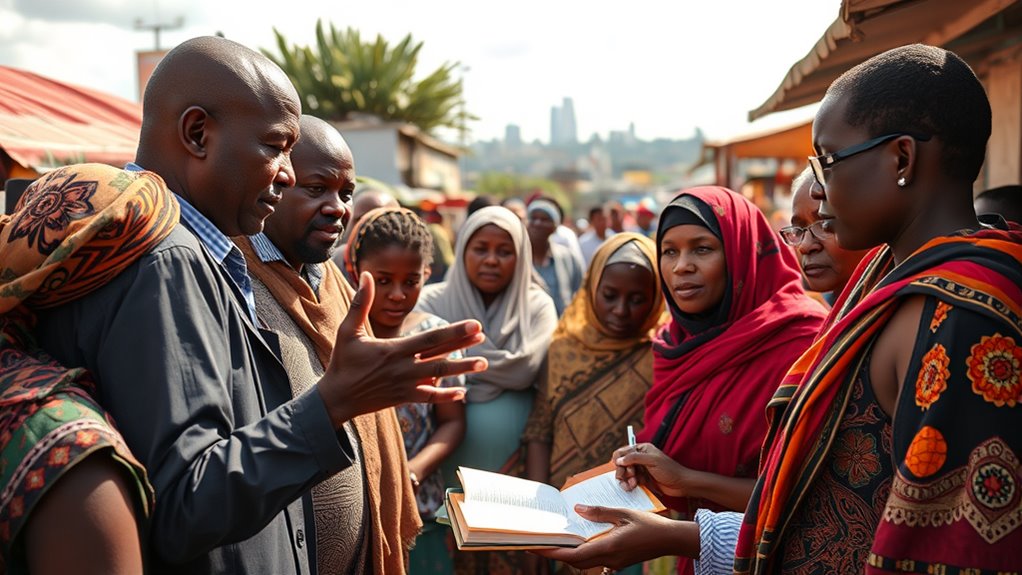
In Kenya, English to Somali translation serves as an essential tool for facilitating communication across diverse linguistic communities. This process bridges gaps in a multilingual society where Somali speakers, particularly in regions like North Eastern Province, often encounter English as the dominant language in official contexts. For instance, in education, accurate translations enable Somali students to access curricula and participate effectively in classrooms. In healthcare, it guarantees that medical information is clearly conveyed, preventing misunderstandings that could affect patient care. Business interactions also benefit, as translations foster trade between English-speaking entities and Somali communities, enhancing economic inclusion. Additionally, it supports legal proceedings by making court documents and proceedings accessible, thereby upholding justice and social equity. Overall, such translation promotes cultural understanding and national unity in Kenya’s vibrant linguistic landscape.
Benefits of Professional Translation Services in Africa

Professional translation services in Africa enhance cross-cultural communication by guaranteeing accuracy and cultural nuance in diverse linguistic contexts. These services facilitate international business by enabling seamless negotiations and market expansion, reducing misunderstandings that could lead to financial losses. In education, they provide access to global resources, empowering learners and institutions to thrive. Healthcare sectors benefit from precise translations, improving patient care and treatment adherence. Legally, they guarantee documents are accurately interpreted, upholding justice and compliance. Additionally, these services support diplomacy and community development, fostering stronger regional ties. By maintaining high standards, professional translators promote economic growth and social harmony, making them indispensable for Africa’s progress. Overall, they minimize errors and maximize efficiency in multilingual environments.
Key Differences Between English and Somali Languages
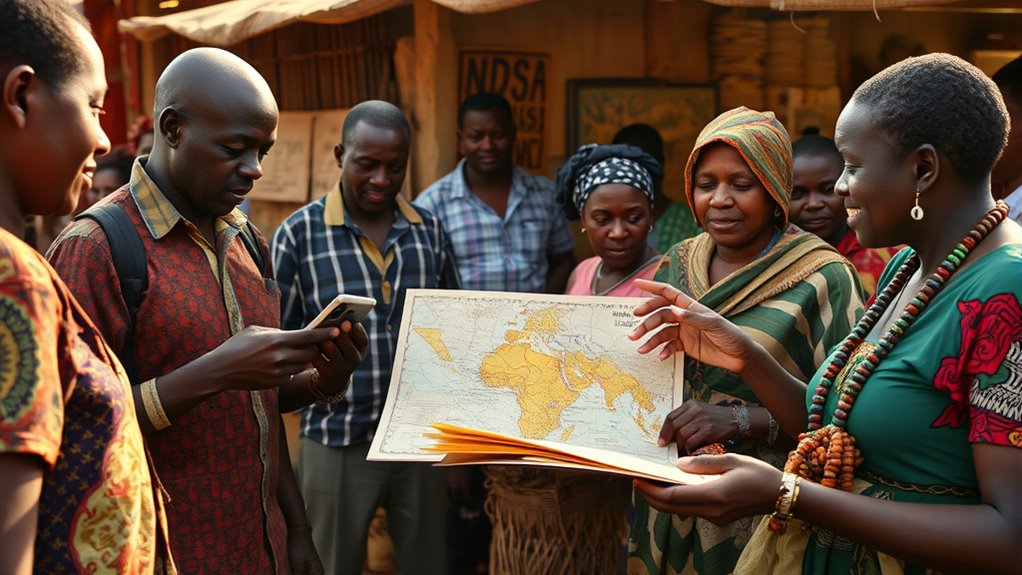
While English belongs to the Indo-European family and Somali to the Afro-Asiatic family, their key differences lie in grammar, phonology, and vocabulary. In grammar, English relies on a flexible subject-verb-object structure with auxiliary verbs and minimal inflection, whereas Somali uses a more rigid subject-object-verb order and employs agglutinative features, such as extensive suffixes for tense, case, and gender. This affects sentence construction and complexity. Phonologically, English features vowel reductions and consonant clusters, while Somali includes distinctive sounds like ejective consonants and pharyngeals, which are absent in English and challenge pronunciation for learners. Vocabulary differs markedly; English draws from Germanic, Latin, and French roots, resulting in a vast lexicon influenced by global interactions, whereas Somali’s vocabulary stems from Cushitic origins with significant Arabic loanwords, reflecting its cultural and historical context. These contrasts highlight the challenges in translation, requiring careful adaptation to maintain meaning and nuance. Understanding these differences aids effective communication in multilingual settings like Kenya.
Top Translation Agencies for Somali in Kenya
Several translation agencies in Kenya specialize in English to Somali services, offering reliable options for individuals and businesses. These top agencies provide a range of services, including document translation, interpretation, and localization. An overview of their offerings highlights their role in bridging language barriers effectively.
Top Agencies
In Kenya, top translation agencies for English to Somali excel in delivering precise and reliable services, catering to diverse sectors such as business, education, and government. These agencies, including Translation Africa and Somali Language Experts, stand out due to their teams of certified linguists with deep cultural knowledge and proficiency in both languages. They prioritize accuracy through rigorous quality checks and advanced tools, ensuring seamless communication for clients. With a strong presence in Nairobi and beyond, these firms handle high-volume projects efficiently, supporting Kenya’s growing international engagements. Their commitment to confidentiality and client satisfaction has earned them stellar reputations, making them go-to choices for professional translations. Overall, these leaders in the field foster effective cross-cultural exchanges in a competitive market.
Services Overview
Top translation agencies in Kenya deliver a range of specialized services for Somali language needs, including document translation, interpretation, and cultural localization. These agencies employ skilled linguists and cultural experts to bridge communication gaps effectively, ensuring precision in business, legal, and community contexts. Their services cater to diverse sectors, from healthcare to education, while prioritizing confidentiality and quality.
To highlight key offerings:
- Document Translation: Converts English texts to Somali for official documents, contracts, and reports, maintaining accuracy and tone.
- Interpretation Services: Provides real-time oral translation for meetings, events, and negotiations, fostering seamless interactions.
- Cultural Localization: Adapts content to Somali cultural nuances, enhancing relevance and engagement for target audiences.
This approach supports global connectivity and mutual understanding.
Cultural Nuances in Somali Language Translation
Cultural nuances profoundly shape English to Somali translations, with the impact of cultural idioms altering meanings in subtle ways. Dialect variations across Somali regions require careful consideration to guarantee fidelity in communication. Social context effects determine how translated content resonates within specific cultural settings.
Cultural Idioms Impact
Idioms in Somali culture frequently introduce nuances that challenge English translations, as they embed deep cultural references like nomadic traditions or oral storytelling. These expressions often lose their essence when rendered literally, potentially altering intended meanings and cultural depth in cross-language contexts.
Translators face specific hurdles in adapting such idioms, which can be outlined as follows:
- Cultural Context Loss: Somali idioms, such as those referencing clan systems, may confuse English audiences without equivalent cultural analogs, leading to misinterpretations.
- Figurative Complexity: Phrases involving metaphors from Somali heritage, like animal symbolism, require creative rephrasing to convey emotional weight accurately.
- Preservation of Tone: Ensuring humor, wisdom, or sarcasm in idioms translates effectively demands sensitivity to avoid flattening the original vibrancy.
This approach enhances communication by bridging cultural gaps, fostering better understanding in global interactions. (124 words)
Dialect Variations Explained
While Somali is often viewed as a single language, its dialects vary widely across regions such as Northern, Central, and Southern Somalia, each shaped by local histories and traditions. In Northern Somalia, for instance, the dialect features harsher phonetics and Bedouin influences, reflecting nomadic heritage, while Central dialects incorporate Arabic loanwords due to trade and Islamic ties. Southern variants, influenced by Bantu interactions, exhibit softer tones and unique vocabulary, underscoring agricultural roots. These differences pose challenges in English to Somali translation, where cultural nuances must be preserved to avoid misinterpretation. Translators must navigate lexical variations—such as distinct terms for kinship or environment—to guarantee fidelity. Ultimately, recognizing these dialectal subtleties enhances accuracy, fostering effective cross-cultural communication in professional contexts like Kenya’s Translation Africa services. (124 words)
Social Context Effects
The interplay of social contexts greatly influences Somali language translation, where cultural nuances often determine the accuracy of conveyed meanings. In Kenya and beyond, translators must navigate societal norms, such as clan affiliations and gender dynamics, to avoid misinterpretations that could alter intent. For instance, indirect communication in Somali culture requires subtle adjustments for Western directness.
Effective translation hinges on these key considerations:
- Cultural Sensitivity: Understanding taboos, like references to family honor, guarantees respectful and precise renditions.
- Contextual Adaptation: Adapting idioms to reflect Somali oral traditions prevents literal errors that lose emotional depth.
- Social Awareness: Recognizing regional variations in customs, such as pastoralist lifestyles, enhances relevance and relatability.
Applications of Translation in Kenyan Businesses
Kenyan businesses leverage English to Somali translation to enhance communication in diverse settings, such as trade and customer service. In trade, companies facilitate smoother negotiations and partnerships with Somali-speaking clients, reducing misunderstandings and fostering trust. For instance, exporters in Kenya use translated documents to navigate cross-border deals in East Africa, where Somali is prevalent. In customer service, retail and hospitality sectors employ translation tools to assist Somali-speaking patrons, improving satisfaction and loyalty. Additionally, marketing firms adapt campaigns to reach Somali demographics, ensuring culturally resonant messaging that boosts engagement. Educational institutions and NGOs also apply these translations for training programs, enabling broader access to resources. Overall, such applications drive efficiency, cultural inclusivity, and economic growth in Kenya’s dynamic business landscape.
Steps for High-Quality English to Somali Translation
Achieving high-quality English to Somali translation requires a systematic approach that prioritizes accuracy and cultural sensitivity. This process guarantees that translations not only convey the original meaning but also respect Somali cultural contexts, particularly in Kenya’s diverse linguistic landscape. By following structured steps, translators can deliver reliable results that foster effective communication.
- Research cultural and contextual elements: Begin by analyzing the source text’s cultural references, idioms, and social nuances to adapt them appropriately for Somali audiences, preventing misunderstandings.
- Translate with precision and expertise: Use bilingual professionals who possess deep knowledge of both English and Somali, focusing on accurate vocabulary, grammar, and regional dialects to maintain fidelity.
- Edit and proofread rigorously: Review the translation for errors, clarity, and flow, incorporating feedback from native Somali speakers to refine and guarantee the final product is polished and culturally resonant.
Technology Innovations in Language Translation
Innovations in technology have revolutionized language translation, enhancing accuracy and efficiency through tools like neural machine translation and AI algorithms. These systems utilize deep learning to process complex linguistic structures, such as Somali’s tonal variations and morphology, delivering more nuanced results. In Kenya, AI-driven platforms enable seamless English to Somali conversions for professional and everyday use, integrating with mobile applications for instant access. Machine learning models continuously refine outputs by analyzing vast datasets, minimizing inaccuracies in context and idioms. Additionally, cloud-based services offer scalable solutions, allowing real-time translations in education, business, and healthcare. This progress democratizes language access, fostering effective communication across diverse African communities without relying on human interpreters alone. Overall, these innovations streamline workflows and promote cultural connectivity in a globalized world.
Challenges of Translating English to Somali
Translating English to Somali presents notable challenges that affect accuracy and effectiveness. Linguistic barriers, such as differences in grammar and vocabulary, often hinder precise word-for-word conversions. Cultural nuances add another layer of complexity, requiring translators to adapt meanings for contextual appropriateness.
Linguistic Barriers
Linguistic barriers pose significant challenges in English-to-Somali translation, stemming from fundamental differences in grammar, syntax, and vocabulary. These issues often lead to inaccuracies, as English relies on subject-verb-object structures, while Somali frequently uses subject-object-verb ordering, complicating sentence flow. Translators must navigate these complexities to maintain meaning.
To illustrate, consider the following key challenges:
- Grammar discrepancies: Somali’s extensive use of gender and case markings contrasts with English’s simpler system, often requiring structural adjustments that alter nuance.
- Syntax variations: English’s complex clauses and prepositions lack direct Somali equivalents, making faithful rendering difficult without rephrasing.
- Vocabulary gaps: Many English terms, especially technical ones, have no precise Somali counterparts, necessitating creative adaptations or borrowing.
Overcoming these demands skilled expertise to guarantee effective communication.
Cultural Nuances
Beyond linguistic barriers, cultural nuances greatly complicate English-to-Somali translation by introducing subtleties that reflect differing societal values, traditions, and contexts. For example, Somali idioms often stem from nomadic lifestyles and clan structures, such as metaphors involving camels or kinship, which lack direct English equivalents and can alter intended meanings. In Kenya’s multicultural setting, translators must carefully adapt references to Islamic customs or gender roles to prevent misunderstandings in areas like healthcare or business. Failing to address these subtleties risks offense or inaccuracy, as English’s individualistic tone may clash with Somali’s communal emphasis. Therefore, skilled translators employ cultural expertise to bridge gaps, ensuring messages resonate appropriately and maintain authenticity in cross-cultural exchanges. This approach enhances communication effectiveness in diverse African contexts.
Emerging Trends in African Translation Services
As the demand for multilingual communication grows across Africa, translation services are adapting through innovative technologies and community-driven initiatives. In Kenya and beyond, these services are evolving to meet diverse linguistic needs, blending digital tools with cultural sensitivity to bridge communication gaps effectively.
- AI Integration: Advanced machine learning algorithms are enhancing accuracy in real-time translations, reducing errors in languages like Somali while maintaining contextual relevance.
- Mobile Accessibility: Apps and platforms are making translation services portable, allowing users in remote areas to access instant conversions via smartphones, fostering broader inclusion.
- Community Collaboration: Local linguists and volunteers are partnering with firms to refine translations, ensuring authenticity and addressing niche dialects for more relatable outcomes.
Frequently Asked Questions
How Much Does English to Somali Translation Cost?
The question addresses the cost of English to Somali translation services. Such costs vary based on factors like word count, document complexity, urgency, and provider expertise. Typically, rates range from $0.05 to $0.20 per word, though exact pricing depends on specific circumstances.
What Qualifications Do Translators Typically Have?
Translators typically possess a bachelor’s degree in languages, translation, or linguistics, along with fluency in at least two languages. Professional certifications from bodies like the ATA and relevant experience guarantee accuracy and cultural competence in their work.
How Long Does a Standard Translation Take?
The time for a standard translation varies based on text length, complexity, and resources. Simple documents may take hours to a day, while complex ones could require several days to weeks, depending on the project. Factors like translator expertise also influence timelines.
Is Translation Service Confidential and Secure?
Translation services are expected to prioritize confidentiality and security, employing measures like encryption, secure servers, and non-disclosure agreements to protect client data from breaches. Reputable providers adhere to industry standards, ensuring sensitive information remains safeguarded throughout the process.
Can I Use Free Tools for Basic Translations?
The use of free tools for basic translations is possible and offers convenient access for simple needs. However, these tools often lack accuracy, especially with nuanced language, and may compromise security, making professional services preferable for reliable results.