
 Elizabeth123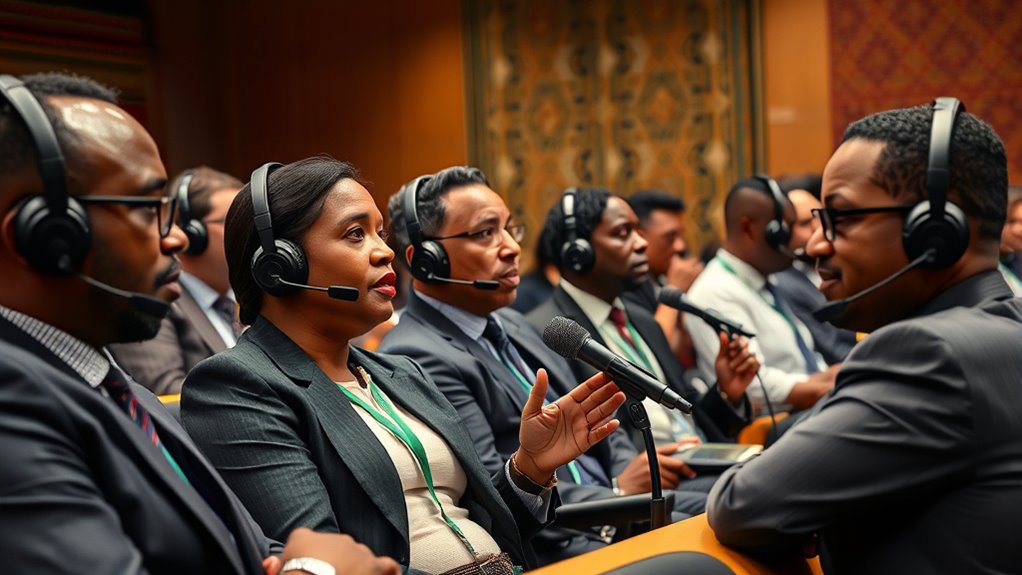
Translation Africa streamlines the hiring of simultaneous interpreters in Ethiopia for international events and negotiations. Clients initiate the process by contacting the company via website or phone, detailing event requirements like languages and logistics. An initial assessment leads to a customized quote and formal contract, covering costs, timelines, payment terms, and interpreter selection based on expertise and availability. This guarantees reliable, high-quality service delivery. Further details on benefits and qualifications await in the outlined sections.
Quick Summaries
- Translation Africa provides a streamlined hiring process for simultaneous interpreters in Ethiopia, including initial assessments and customized quotes.
- Simultaneous interpretation from Translation Africa bridges language barriers, enabling real-time communication in international events.
- Interpreters hired through Translation Africa must possess fluency in multiple languages and relevant certifications for accurate conveyance.
- Services account for Ethiopia’s cultural nuances, such as indirect communication and respect for hierarchical structures, to ensure effective interpretation.
- Costs for hiring include interpreter rates, equipment like soundproof booths, and logistics for events in Ethiopia.
Benefits of Simultaneous Interpretation in Ethiopia
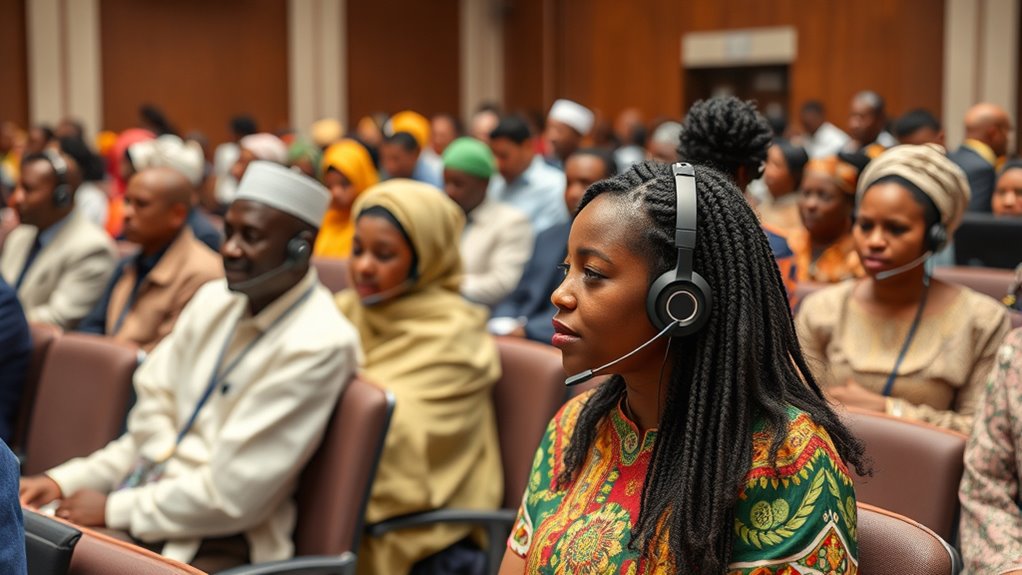
Simultaneous interpretation offers key advantages in Ethiopia, particularly in bridging language gaps during events like international conferences and business negotiations. By delivering real-time translation, it guarantees participants grasp complex ideas without delays, enhancing overall communication flow. This efficiency is essential in Ethiopia’s multilingual context, where diverse languages can hinder collaboration. It preserves the subtleties of tone and context, fostering deeper cultural understanding and trust among stakeholders. In educational forums, simultaneous interpretation promotes inclusive learning, allowing students from various backgrounds to engage fully. For diplomatic engagements, it facilitates accurate exchanges, reducing misinterpretations that could escalate conflicts. Ultimately, these benefits drive Ethiopia’s global connectivity, supporting economic and social progress through seamless multilingual interactions.
How to Hire Interpreters From Translation Africa

Understanding the hiring process for interpreters from Translation Africa requires following specific steps to guarantee effective service. The selection of interpreters focuses on matching expertise with project needs for best results. Finalizing arrangements involves confirming details to complete the engagement smoothly.
Hiring Process Steps
The hiring process for interpreters from Translation Africa involves key steps to secure qualified professionals in Ethiopia. Clients start by contacting the company through their website or phone to outline interpretation requirements, including event type and language needs. Translation Africa then conducts an initial assessment to gather detailed information on duration and logistics. Following this, the company prepares a customized quote, outlining costs, timelines, and service inclusions. Once approved, a formal contract is drafted, specifying terms like payment and scheduling. Translation Africa subsequently handles coordination, such as assigning resources and confirming availability. Clients are advised to respond promptly to inquiries to guarantee efficiency. This structured process emphasizes clear communication and timely execution, facilitating seamless arrangements without unnecessary delays.
Selecting Interpreters
When clients seek to hire interpreters from Translation Africa, they should evaluate factors such as language expertise, experience, and availability to assure a suitable match for their needs. Language expertise involves verifying fluency in both source and target languages, including dialects common in Ethiopia, to guarantee accurate real-time translation. For instance, interpreters must handle nuances in Amharic, Oromo, or other local languages while maintaining precision during simultaneous sessions. Experience is essential; clients should review portfolios for prior work in similar settings, such as conferences or business meetings, to gauge reliability and adaptability. Availability requires checking schedules to align with event timelines, preventing last-minute issues. Translation Africa offers a vetted pool of professionals, allowing clients to request references and conduct initial consultations. By prioritizing these elements, organizations can select interpreters who enhance communication effectively in Ethiopia’s diverse linguistic landscape.
Finalizing Arrangements
After selecting interpreters, clients can finalize arrangements with Translation Africa by submitting a formal request, confirming details such as dates, locations, and fees, and signing a contract to guarantee seamless service delivery. This process guarantees all parties are aligned, minimizing risks and enhancing event success. Translation Africa emphasizes clear communication to address any last-minute adjustments.
To streamline finalization, consider these steps:
- Review contract terms thoroughly to understand obligations, cancellation policies, and liability coverage.
- Confirm payment methods early, opting for secure options like bank transfers or online platforms to avoid delays.
- Coordinate logistics such as venue access and equipment needs, guaranteeing interpreters have what they require.
- Schedule a final confirmation call to verify all details and build rapport for better on-site performance.
Qualifications for Professional Simultaneous Interpreters
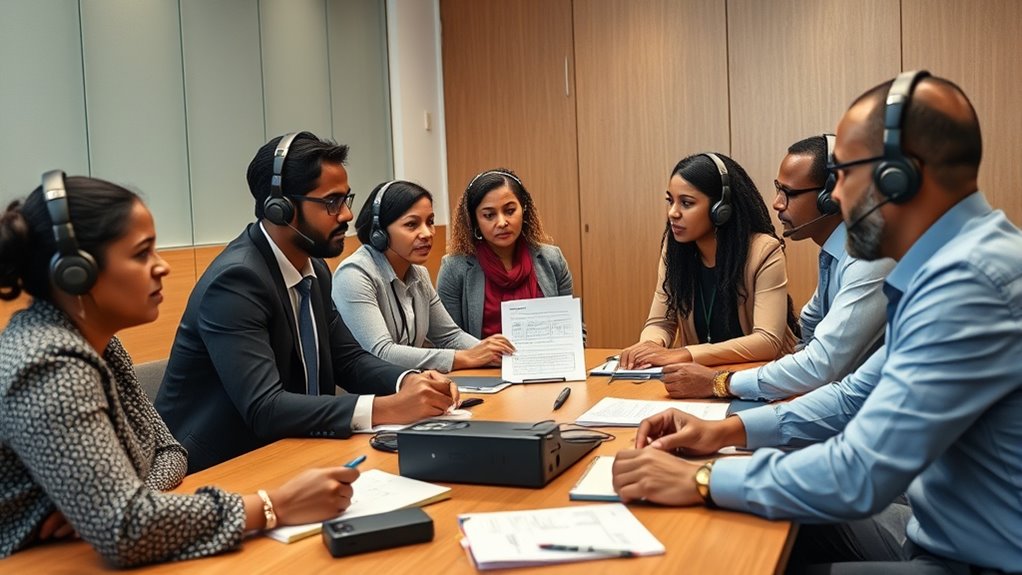
Professional simultaneous interpreters in Ethiopia need specific qualifications to perform effectively. Language proficiency stands as a core requirement, demanding exceptional fluency in the source and target languages. Certification requirements further guarantee that interpreters meet industry standards for accuracy and reliability.
Language Proficiency
Language proficiency serves as the foundational qualification for simultaneous interpreters, demanding fluency in at least two languages to accurately convey meaning in real-time. This expertise guarantees seamless communication, where interpreters must handle complex linguistic elements without delay, adapting to various dialects and contexts in high-stakes settings like conferences or diplomatic events.
- Vocabulary Mastery: Interpreters need extensive knowledge of specialized terminology in fields such as medicine or law to translate accurately.
- Grammatical Precision: A deep understanding of syntax and structure in both languages prevents misinterpretations during rapid exchanges.
- Pronunciation and Fluency: Clear, natural speech is essential for maintaining the flow of conversation and audience comprehension.
- Nuance Recognition: Ability to interpret idioms, metaphors, and cultural subtleties guarantees faithful rendering of intent.
Certification Requirements
Beyond language proficiency, certifications serve as formal validations for simultaneous interpreters, encompassing recognized credentials from bodies like the International Association of Conference Interpreters or national equivalents in Ethiopia. These certifications typically demand rigorous training programs, including advanced courses in simultaneous interpreting techniques, ethical standards, and specialized examinations. For example, AIIC certification requires extensive practical experience and adherence to professional codes, ensuring interpreters can handle multilingual conferences with precision. In Ethiopia, equivalents might include qualifications from the Ethiopian Translators and Interpreters Association or internationally recognized programs, which assess language mastery and cultural competence. Such credentials enhance reliability, reducing errors in real-time translation scenarios. Employers seeking simultaneous interpreters in Ethiopia should verify these certifications to guarantee high-quality performance, as they signify a commitment to ongoing professional development and industry best practices. This focus on certified expertise ultimately supports effective cross-cultural communication in diverse settings.
Applications of Simultaneous Interpretation in Business
Simultaneous interpretation plays a pivotal role in business by facilitating real-time communication across languages during conferences, negotiations, and global meetings, enabling seamless collaboration and decision-making. This service guarantees that multinational companies can operate efficiently, breaking down language barriers that might otherwise hinder productivity. By providing instant translation, it supports informed discussions and fosters trust among diverse stakeholders.
- Enhances global conferences: Allows participants from different countries to engage fully, promoting idea exchange without delays.
- Facilitates negotiations: Enables smooth bargaining in international deals, where precise wording can influence outcomes.
- Supports virtual meetings: Keeps remote teams aligned in real time, improving efficiency in cross-border projects.
- Aids training sessions: Delivers accurate information during employee onboarding or skill development for global workforces.
Cultural Considerations for Ethiopian Interpretation Services
When providing interpretation services in Ethiopia, cultural nuances such as respect for hierarchical structures and communal communication styles must be carefully addressed to guarantee accurate and sensitive exchanges. Interpreters must navigate Ethiopia’s diverse ethnic groups, including Amhara, Oromo, and Tigrayan traditions, where indirect language avoids confrontation and honors social harmony. For instance, elders and authority figures often receive deference, influencing dialogue flow in business or diplomatic settings. Non-verbal cues, like prolonged eye contact or specific gestures, carry significant meaning and should be interpreted contextually to prevent misunderstandings. Additionally, communal decision-making processes emphasize group consensus, requiring interpreters to facilitate inclusive discussions without imposing Western individualism. Sensitivity to religious practices, such as Orthodox Christian customs, further guarantees respectful interactions, fostering trust and effective communication in multicultural environments.
Differences Between Simultaneous and Other Interpretation Types
Interpreters must distinguish simultaneous interpretation, which delivers real-time translation without interrupting the speaker, from consecutive methods that involve pauses for rendering speech in another language, as well as other forms like whispering or liaison interpreting. Simultaneous interpretation enables uninterrupted flow in large-scale events, demanding high cognitive agility, while consecutive interpretation allows for note-taking and greater detail in smaller settings. Whispering provides discreet translation for a few listeners, and liaison facilitates brief, back-and-forth exchanges in informal contexts.
- Real-time vs. Delayed Delivery: Simultaneous translates instantly, whereas consecutive waits for speaker pauses, affecting event pacing.
- Cognitive Demands: Simultaneous requires split-second processing, contrasting with the methodical approach of consecutive or whispering methods.
- Audience Interaction: Simultaneous maintains speaker momentum, unlike consecutive, which involves direct audience engagement through breaks.
- Application Suitability: Simultaneous excels in conferences, while whispering and liaison are better for intimate or business discussions.
Equipment Requirements for Simultaneous Interpretation
Effective simultaneous interpretation relies on specialized equipment to guarantee accurate, real-time translation. Essential components include soundproof booths, which isolate interpreters from ambient noise for ideal concentration. High-quality headsets and microphones enable clear audio input and output, allowing interpreters to process and relay information swiftly. For audiences, wireless receivers deliver uninterrupted sound, while transmitters and mixers guarantee reliable signal distribution across venues. A central control system manages these elements, minimizing latency and maintaining synchronization with the speaker. Proper calibration of audio levels and equipment compatibility is essential to prevent distortions, supporting seamless multilingual communication in events like conferences. This setup enhances overall interpretation quality, fostering effective cross-language interaction.
Cost Factors in Hiring Interpreters in Ethiopia
Hiring simultaneous interpreters in Ethiopia involves multiple cost factors that can substantially influence overall expenses. These include interpreter qualifications, event specifics, and operational logistics, all varying by project scale. Understanding these elements helps in budgeting effectively for language services.
- Interpreter Rates: Fees depend on experience and language pairs, often charged hourly or daily, with experts commanding higher premiums in Ethiopia.
- Event Duration and Complexity: Longer sessions or specialized topics increase costs due to extended preparation and performance time required.
- Travel and Logistics: Expenses for interpreters’ transportation, accommodation, and on-site support, especially for remote locations, add to the total.
- Additional Services: Costs for technical setup, certification verification, or team coordination can escalate based on service needs.
Success Stories With Simultaneous Interpreters
Several success stories illustrate the impact of simultaneous interpreters in Ethiopia. Ethiopian event triumphs showcase how these professionals enabled flawless multilingual interactions during key gatherings. Interpreter impact cases further reveal their role in enhancing outcomes across diverse sectors.
Ethiopian Event Triumphs
Ethiopian events have flourished thanks to skilled simultaneous interpreters, who have transformed multilingual gatherings into seamless successes. These experts bridge language gaps, fostering collaboration and cultural exchange in diverse settings. Their precision guarantees that participants from various backgrounds engage fully, elevating the overall experience and outcomes of key gatherings.
- Enhanced conference dynamics: Interpreters enabled real-time dialogue in international forums, boosting idea sharing and decision-making.
- Cultural festival vibrancy: Events like festivals gained inclusivity, with attendees from multiple languages participating actively and appreciating performances.
- Business meeting efficiency: Negotiations in trade events proceeded smoothly, allowing stakeholders to communicate ideas without delays.
- Community event engagement: Local gatherings saw higher attendance and interaction, as interpreters made content accessible to all participants.
Interpreter Impact Cases
Numerous success stories underscore the transformative effects of simultaneous interpreters in diverse settings, where they have enabled fluid communication and fostered meaningful interactions among participants. In Ethiopia, for instance, interpreters facilitated a high-stakes international trade conference, allowing delegates from Europe and Asia to negotiate deals worth millions, ultimately boosting local economies. Another case involved a medical symposium in Addis Ababa, where interpreters guaranteed accurate exchange of essential health information, leading to improved healthcare strategies and partnerships. In a diplomatic forum, their expertise averted misunderstandings during peace talks, promoting regional stability. These examples highlight how simultaneous interpreters from Translation Africa enhance cross-cultural dialogue, driving successful outcomes in business, health, and diplomacy. Their precision minimizes errors, empowering participants to achieve shared goals efficiently.
Training Programs for Interpreters at Translation Africa
Translation Africa offers rigorous training programs for interpreters, emphasizing simultaneous skills through practical exercises and expert-led modules. These programs are designed to build expertise in real-time language conversion, ensuring participants gain proficiency in high-pressure environments. By focusing on quality and adaptability, Translation Africa equips interpreters with essential tools for effective communication.
- Interactive simulations: Trainees practice with live scenarios to mimic conference settings, enhancing quick thinking and accuracy.
- Expert mentorship: Seasoned professionals provide personalized feedback on technique and cultural nuances.
- Language mastery modules: Thorough lessons cover advanced vocabulary, dialects, and regional variations in Ethiopia.
- Assessment and certification: Rigorous evaluations lead to accredited certifications, validating skills for professional use.
This structured approach fosters competent interpreters ready for diverse demands.
Using Interpreters for Conferences and Events
Interpreters are essential for ensuring seamless communication at conferences and events involving multiple languages. They bridge linguistic gaps, allowing participants from diverse backgrounds to engage fully and effectively. In large-scale gatherings, such as international summits or business meetings in Ethiopia, simultaneous interpreters use advanced equipment like headsets and booths to translate speech in real-time, minimizing delays and maintaining the event’s flow. This technique enhances comprehension, fosters collaboration, and prevents misunderstandings that could derail discussions. For best results, event organizers should select interpreters with expertise in the subject matter, ensuring accuracy and cultural sensitivity. Additionally, proper planning, including pre-event briefings and technical setup, is vital to handle the demands of high-stakes environments. Ultimately, skilled interpreters elevate the overall experience, promoting inclusivity and successful outcomes.
Why Select Translation Africa for Interpretation Needs
Translation Africa stands out as a preferred provider for interpretation services in Ethiopia due to its key strengths. The company employs expert interpreters with specialized skills in simultaneous translation. Additionally, it delivers reliable services that guarantee seamless communication during events.
Expert Interpreters
In Ethiopia’s dynamic interpretation landscape, Translation Africa stands out for its team of highly skilled interpreters, who bring precision and cultural fluency to every assignment. These experts excel through specialized training and deep linguistic mastery, ensuring seamless communication in Ethiopia’s multicultural environment. Their proficiency transforms complex interactions into clear exchanges, fostering effective outcomes.
- Extensive experience: Interpreters handle diverse sectors like business and conferences with proven expertise.
- Multilingual proficiency: Coverage of Amharic, Oromo, and other key languages for accurate real-time translation.
- Cultural insight: Deep understanding of Ethiopian customs to bridge gaps and enhance comprehension.
- Rigorous certification: Adherence to international standards, guaranteeing high-quality performance in every session.
Reliable Services
Businesses requiring interpretation in Ethiopia find Translation Africa‘s services exceptionally reliable, offering consistent accuracy and timely delivery to meet diverse client needs. The company employs rigorous quality control measures, ensuring interpreters are vetted for expertise and cultural sensitivity, which minimizes errors in high-stakes environments. Clients benefit from flexible scheduling and 24/7 availability, allowing seamless adaptation to urgent demands. Translation Africa prioritizes confidentiality with secure protocols, fostering trust in sensitive sectors like diplomacy and business. Their commitment to ongoing training keeps services aligned with global standards, reducing risks of miscommunication. This focus on dependability, backed by positive feedback from multinational firms, positions Translation Africa as a preferred partner for professional interpretation in Ethiopia. Their tailored solutions enhance efficiency, ultimately supporting business success.
Technological Tools in Simultaneous Interpretation
Technological tools have revolutionized simultaneous interpretation by enabling real-time language processing and seamless communication. These advancements enhance accuracy and efficiency, particularly in Ethiopia’s multilingual settings, where interpreters rely on cutting-edge solutions to overcome barriers. By integrating hardware and software, professionals deliver high-quality services in various contexts, from conferences to business meetings.
- AI-powered translation software: Processes speech in real-time, reducing errors and boosting speed.
- Wireless headsets and microphones: Guarantee clear audio transmission for interpreters and participants.
- Specialized terminology databases: Provide quick access to industry-specific vocabulary for precision.
- Cloud-based platforms: Allow remote collaboration, making interpretation accessible from any location.
Legal Aspects of Interpretation Services in Ethiopia
The legal framework governing interpretation services in Ethiopia establishes essential standards for accuracy, confidentiality, and professional conduct. Ethiopia’s laws, including the Federal Negarit Gazeta and international treaties like the Vienna Convention, mandate interpreters to uphold impartiality and protect sensitive information. The Ministry of Justice oversees compliance, ensuring that services meet ethical guidelines to prevent miscommunication in legal, diplomatic, and business contexts. Violations, such as breaches of confidentiality, can lead to severe penalties, including fines or professional bans, emphasizing the role of certified interpreters. Professional bodies, like the Ethiopian Translators Association, enforce codes of ethics, promoting high standards in multilingual settings. This regulatory environment fosters trust and reliability, vital for effective cross-cultural communication while safeguarding national interests. Overall, adherence to these legal aspects enhances the integrity of interpretation services in Ethiopia.
Preparation Tips for Effective Interpretation Sessions
Effective preparation forms the foundation of successful interpretation sessions, enabling interpreters to handle the complexities of simultaneous translation with precision and poise. In Ethiopia’s diverse linguistic landscape, thorough groundwork guarantees seamless communication during events like conferences or legal proceedings. Interpreters must anticipate challenges, such as cultural nuances and technical issues, to deliver accurate results.
- Research the topic thoroughly: Familiarize with subject matter in advance to grasp key concepts and context.
- Build a glossary of terms: Compile and review specialized vocabulary relevant to the session for quick recall.
- Test equipment and setup: Verify headsets, microphones, and software to avoid disruptions during live interpretation.
- Practice mental and physical readiness: Engage in simulations and relaxation techniques to maintain focus and stamina throughout the event.
This approach enhances reliability and client satisfaction in Ethiopia’s interpretation services.
Frequently Asked Questions
What Payment Methods Do You Accept?
The query seeks information on accepted payment methods. The organization facilitates transactions via major credit cards like Visa and Mastercard, bank transfers, and digital options such as PayPal and Stripe, ensuring flexibility and security for clients.
Can I Cancel a Booking Easily?
The question of easily canceling a booking is common among users. Generally, cancellations can be straightforward if initiated promptly, adhering to the provider’s policy, which often includes a grace period and possible fees. Clients should review terms beforehand to guarantee a smooth process.
Do You Offer Remote Interpretation?
The question regarding remote interpretation services is whether they are available. Many translation providers offer this option, utilizing digital platforms for real-time language support in meetings, conferences, and events, ensuring effective communication globally.
How Do I Request a Specific Interpreter?
Requesting a specific interpreter typically involves clients contacting the service provider directly, providing the interpreter’s name, language expertise, and event details. This process guarantees availability, suitability, and proper coordination for the assignment. Further verification may be required.
What Is Your Feedback Process?
The feedback process involves clients submitting evaluations through a dedicated online platform. These submissions are reviewed by a neutral team, who analyze feedback to identify improvements, ensuring service quality and user satisfaction are enhanced systematically.