 directlineauthors
Central Africa’s linguistic landscape presents unique challenges for businesses, organizations, and individuals seeking to communicate across cultural boundaries. Among the region’s most significant languages, Lingala stands as a bridge connecting millions of people across the Democratic Republic of Congo, Republic of Congo, Central African Republic, and Angola.
This Bantu language, spoken by over 15 million people as a native tongue and understood by millions more as a second language, represents far more than mere words on paper—it carries the heartbeat of Central African culture, commerce, and community.
The complexity of Lingala translation extends beyond simple word conversion. Professional translators must navigate intricate cultural nuances, regional dialects, and contextual meanings that can dramatically alter message interpretation.
Whether you’re expanding your business into Central African markets, conducting humanitarian work, or maintaining family connections across continents, accurate Lingala translation becomes the foundation of meaningful communication. Directline Translators understands these complexities and provides specialized services that honor both linguistic precision and cultural authenticity.
What makes Lingala translation particularly challenging—and why professional expertise matters so much—lies in the language’s rich oral tradition, its evolution through colonial and post-colonial periods, and its adaptation to modern technological and business terminology.
Stay with us as we explore the intricate world of Lingala translation services, from understanding regional variations to selecting the right translation partner for your specific needs.
Professional Lingala Translation Services: Bridging Communication Gaps
Professional Lingala translation services require deep understanding of both linguistic structure and cultural context. Native speakers of Lingala often communicate through subtle implications, shared cultural references, and contextual meanings that automated translation tools simply cannot capture.
Directline Translators employs certified linguists who grew up immersed in Lingala-speaking communities, ensuring translations maintain both accuracy and cultural appropriateness.
The scope of professional Lingala translation extends across multiple industries and document types. Legal documents require precise terminology that reflects both Lingala legal concepts and international standards. Medical translations demand accuracy that could literally save lives, while business communications need cultural sensitivity that prevents misunderstandings potentially worth millions of dollars.
Educational materials must balance accessibility with academic rigor, ensuring complex concepts remain comprehensible across different literacy levels within Lingala-speaking communities.
Quality assurance in professional Lingala translation involves multiple verification stages. Initial translation by native speakers undergoes review by subject matter experts familiar with specific industry terminology. Cultural consultants then examine the text for potential misunderstandings or offensive interpretations. Finally, proofreaders ensure grammatical accuracy and stylistic consistency throughout the document.
Technology plays a supporting role in modern Lingala translation services, but human expertise remains irreplaceable. Computer-assisted translation tools help maintain consistency across large projects, while translation memory systems store previously translated segments for future reference.
However, the nuanced nature of Lingala communication means that experienced human translators must always have the final word on translation choices.
Understanding Lingala Translation Complexity in Regional Contexts
Regional variations within Lingala create significant challenges for translation professionals. Kinshasa Lingala, spoken in the Democratic Republic of Congo’s capital, differs substantially from the Lingala used in Brazzaville, Republic of Congo. These differences go beyond mere accent variations—they include vocabulary choices, grammatical structures, and cultural references that can completely change message meaning.
Historical influences have shaped modern Lingala translation requirements. French colonial administration introduced numerous French loanwords that became integrated into everyday Lingala vocabulary. Portuguese influence in northern Angola created another linguistic layer, while contact with other Bantu languages throughout Central Africa contributed additional complexity.
Professional translators must understand these historical layers to choose appropriate terminology for specific audiences.
Urban versus rural Lingala usage presents another translation challenge. City-dwelling Lingala speakers often incorporate more French or English terms, particularly for modern concepts like technology, finance, and international relations. Rural communities may maintain more traditional vocabulary and expressions, requiring translators to adjust their approach based on intended audience demographics.
Religious terminology in Lingala translation requires special consideration. Christianity’s influence throughout Central Africa has created unique religious vocabulary blends, combining traditional spiritual concepts with Christian terminology.
Translating religious texts, whether Christian materials into Lingala or traditional spiritual concepts into other languages, demands deep understanding of both belief systems and their linguistic expressions.
Certified Lingala Translation for Legal and Official Documents
Legal document translation in Lingala requires certified professionals who understand both legal systems and linguistic precision. Court documents, contracts, immigration papers, and official certificates demand accuracy levels that leave no room for interpretation errors. Directline Translators maintains a network of certified legal translators specializing in Lingala who possess both linguistic expertise and legal training.
Immigration-related Lingala translation services have become increasingly important as Central African communities establish themselves globally. Birth certificates, marriage licenses, educational transcripts, and professional certifications all require certified translation for immigration purposes.
These documents must meet specific formatting requirements and include translator certifications that immigration authorities will accept.
Contract translation between Lingala and other languages involves complex legal terminology that may not have direct equivalents. Mining contracts, particularly relevant given Central Africa’s rich mineral resources, require translators familiar with both geological terminology and international business practices. Land ownership documents need cultural sensitivity regarding traditional versus modern property concepts.
Judicial proceedings involving Lingala speakers require real-time interpretation services that complement written translation work. Court interpreters must understand legal procedures while maintaining linguistic accuracy under pressure. These professionals often work alongside document translators to ensure consistent terminology across all legal communications.
Business Lingala Translation Solutions for Market Expansion
Market expansion into Central Africa requires sophisticated Lingala translation strategies that go beyond basic language conversion. Consumer behavior, purchasing patterns, and cultural values all influence how marketing messages should be adapted for Lingala-speaking audiences.
Directline Translators works with businesses to develop culturally appropriate marketing materials that resonate with local communities while maintaining brand integrity.
Product documentation translation presents unique challenges in Lingala markets. Technical manuals, safety instructions, and user guides must be accessible to users with varying literacy levels and technical backgrounds. Translators must balance technical accuracy with clear communication, often creating multiple versions for different user segments within the same market.
Financial services documentation requires specialized Lingala translation expertise. Banking terms, insurance policies, and investment materials need careful adaptation to reflect local financial practices and regulatory requirements. Many traditional Lingala-speaking communities have different conceptual approaches to money, savings, and financial planning that must be considered during translation.
E-commerce platforms targeting Lingala-speaking customers need comprehensive translation services covering product descriptions, checkout processes, customer service materials, and return policies. Payment systems familiar to Central African users may differ from international standards, requiring culturally appropriate explanations and instructions.
Medical and Healthcare Lingala Translation Services
Healthcare communication in Lingala requires exceptional precision because translation errors can have life-threatening consequences. Medical terminology translation involves both scientific accuracy and cultural sensitivity regarding health beliefs and practices within Lingala-speaking communities.
Directline Translators employs medical translators with clinical backgrounds who understand both Western medical practices and traditional Central African healing approaches.
Pharmaceutical documentation translation demands regulatory compliance across multiple jurisdictions. Drug labels, dosage instructions, and side effect warnings must be translated with absolute accuracy while remaining comprehensible to patients with varying education levels.
Age-appropriate versions for pediatric medications require special consideration for family-centered healthcare practices common in Central African cultures.
Mental health materials translation presents particular challenges due to cultural attitudes toward psychological wellbeing. Concepts like depression, anxiety, and trauma may require careful explanation and cultural contextualization. Traditional healing practices often address mental health through community support systems that Western psychological approaches may not fully recognize.
Public health campaigns targeting Lingala-speaking populations require translation services that understand community communication patterns. HIV/AIDS prevention materials, vaccination information, and maternal health education must be culturally sensitive while medically accurate. Community leaders and traditional healers often play crucial roles in health information dissemination.
Educational Lingala Translation: Academic and Training Materials
Educational material translation in Lingala must balance academic rigor with cultural relevance and accessibility. Textbooks, curriculum guides, and instructional materials need adaptation for students whose primary education may have occurred in French, Portuguese, or other local languages. Directline Translators creates educational translations that support learning while respecting cultural knowledge systems.
Higher education materials require sophisticated Lingala translation approaches that can handle complex academic concepts. University-level textbooks, research papers, and thesis documents must maintain scholarly precision while remaining accessible to students who may be multilingual but have varying levels of academic Lingala exposure.
Subject-specific terminology databases help ensure consistency across related educational materials.
Technical training materials for vocational education need practical translation approaches that connect international standards with local implementation realities. Mining, agriculture, construction, and healthcare training materials must reflect both global best practices and regional working conditions. Safety protocols require special attention to ensure worker protection regardless of literacy levels.
Distance learning platforms serving Lingala-speaking students require comprehensive translation services covering course content, navigation instructions, assessment materials, and student support resources. Online learning may be new to many Central African communities, requiring additional cultural context and technical explanation.
Cultural Nuances in Lingala Translation and Localization
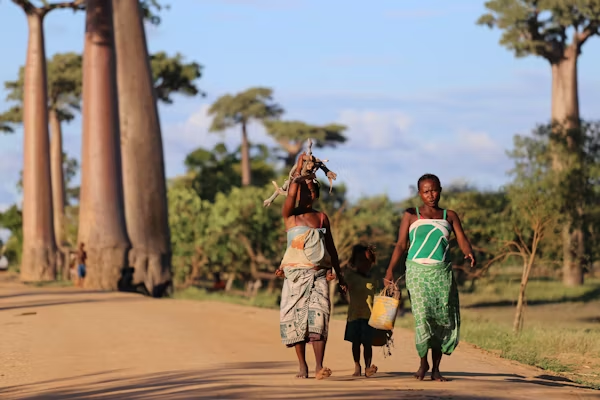
Cultural sensitivity in Lingala translation extends beyond language into deep understanding of Central African social structures, values, and communication styles. Respect hierarchies, age deference, and community decision-making processes all influence how messages should be crafted and presented. Directline Translators incorporates cultural consultants who ensure translations respect these important social dynamics.
Traditional storytelling elements often enhance Lingala communication effectiveness. Proverbs, metaphors, and narrative structures familiar to Central African audiences can make translated content more engaging and memorable. However, these cultural elements must be used appropriately and authentically, avoiding stereotypes or oversimplification.
Gender roles and family structures in Central African cultures may differ significantly from Western assumptions. Translation materials addressing family planning, women’s rights, or child education must be sensitive to local cultural practices while potentially introducing new concepts. Balance between cultural respect and progressive messaging requires skilled translation professionals.
Religious and spiritual references permeate Lingala communication, reflecting the deep faith traditions throughout Central Africa. Even secular documents may benefit from understanding these spiritual frameworks, as they influence worldview, values, and decision-making processes among many Lingala speakers.
Technical Lingala Translation for Specialized Industries
Mining industry documentation requires specialized Lingala translation services that combine geological expertise with environmental and safety considerations. Technical specifications, environmental impact assessments, and worker safety protocols must be translated accurately while remaining accessible to workers with diverse educational backgrounds.
Directline Translators maintains translators with mining industry experience who understand both technical requirements and local working conditions.
Telecommunications and information technology materials need Lingala translation approaches that can handle rapid technological change while building on existing linguistic frameworks. Internet services, mobile banking, and digital communication platforms require explanations that connect new technologies with familiar concepts and practices.
Agriculture and food security documentation requires translation expertise that understands both modern agricultural techniques and traditional farming practices. Seed varieties, fertilizer applications, and crop management strategies must be adapted for local growing conditions and farmer knowledge levels.
Extension services materials need translation approaches that respect traditional agricultural wisdom while introducing beneficial innovations.
Infrastructure development projects require comprehensive Lingala translation services covering engineering documents, community consultation materials, and environmental impact assessments. Road construction, water systems, and electrical grid development all involve community engagement that requires culturally appropriate communication strategies.
Digital Lingala Translation Services and Technology Integration
Modern Lingala translation services integrate digital technologies while maintaining human expertise for quality assurance. Translation memory systems store previously translated segments, ensuring consistency across related documents and reducing turnaround times for large projects. However, the complex cultural context required for effective Lingala translation means that human oversight remains essential.
Website localization for Lingala-speaking audiences involves more than text translation. Navigation structures, color choices, imagery, and user interface design all need cultural adaptation. E-commerce sites must accommodate different payment methods, shipping expectations, and customer service approaches preferred by Central African consumers.
Mobile application translation presents unique challenges given varying smartphone adoption rates across Central African communities. User interfaces must be intuitive for users with different technological comfort levels, while maintaining full functionality. Voice recognition and text-to-speech applications need development specifically for Lingala phonetic patterns.
Social media content translation requires understanding of communication styles specific to different platforms and age groups within Lingala-speaking communities. Hashtag translation, emoji usage, and platform-specific language conventions all need consideration for effective cross-cultural digital communication.
Quality Assurance and Certification in Lingala Translation Projects
Quality assurance protocols for Lingala translation projects involve multiple verification stages designed to ensure accuracy, cultural appropriateness, and client satisfaction. Initial translation by certified native speakers undergoes review by subject matter experts familiar with specific industry requirements. Cultural consultants then examine translations for potential misunderstandings or culturally inappropriate content.
Professional certification for Lingala translators involves both linguistic testing and cultural competency evaluation. Translators must demonstrate fluency in multiple Lingala dialects, understanding of cultural contexts, and expertise in specialized subject areas. Continuing education requirements ensure that certified translators stay current with language evolution and industry developments.
Project management for large-scale Lingala translation initiatives requires coordination between multiple specialists, including translators, reviewers, cultural consultants, and technical specialists. Version control systems track changes throughout the translation process, while quality metrics measure accuracy, consistency, and client satisfaction.
Client feedback integration helps continuously improve Lingala translation services. Regular communication with end users—whether businesses, organizations, or individuals—provides valuable insights into translation effectiveness and areas for improvement. This feedback loop ensures that translation services evolve to meet changing needs and preferences.
Choosing the Right Lingala Translation Partner for Your Needs
Selecting appropriate Lingala translation services requires careful evaluation of translator qualifications, cultural expertise, and industry specialization. Directline Translators provides comprehensive translator profiles that include educational backgrounds, professional certifications, and subject matter expertise. This transparency helps clients make informed decisions about translator selection for specific projects.
Project scope definition helps ensure that Lingala translation services match client requirements and budget constraints. Simple document translation needs differ significantly from comprehensive localization projects involving cultural adaptation, market research, and ongoing linguistic support. Clear communication about project goals prevents misunderstandings and ensures satisfactory outcomes.
Turnaround time expectations must balance quality requirements with project deadlines. Rush translation projects may compromise accuracy or cultural sensitivity, while extended timelines allow for thorough review and quality assurance processes. Realistic scheduling helps ensure that Lingala translation projects meet both quality and deadline requirements.
Cost considerations for Lingala translation services should account for project complexity, subject matter expertise required, and quality assurance needs. While basic document translation may seem straightforward, specialized content often requires premium rates for qualified translators with relevant expertise. Transparent pricing structures help clients budget appropriately for translation services.
FAQs On Lingala Translation: Congo and Central Africa:

1. What makes Lingala translation different from other African language translations? Lingala translation requires understanding of multiple regional variants, French colonial influences, and complex oral tradition elements that don’t exist in written form. The language spans multiple countries with different cultural contexts, making cultural sensitivity particularly important.
2. How long does professional Lingala translation typically take? Translation timelines depend on document length, complexity, and quality requirements. Simple documents may be completed within 24-48 hours, while technical or legal materials often require 3-5 days for proper review and quality assurance processes.
3. Do you provide certified Lingala translations for immigration purposes? Yes, Directline Translators provides certified translations that meet immigration authority requirements. Our certified translators include official seals and signatures required for legal acceptance of translated documents.
4. Can you handle both Kinshasa and Brazzaville Lingala variants? Our translator network includes specialists in different regional Lingala variants. We match translators to projects based on target audience location and dialect preferences to ensure cultural appropriateness.
5. What industries do your Lingala translators specialize in? Our Lingala translation team includes specialists in legal, medical, business, technical, educational, and religious translation. Many translators have advanced degrees or professional experience in their specialization areas.
6. How do you ensure quality in Lingala translation projects? Quality assurance involves multiple review stages: initial translation by native speakers, subject matter expert review, cultural consultation, and final proofreading. We also maintain translation memory systems for consistency across related projects.
7. Can you provide interpretation services alongside Lingala translation? Yes, we offer both consecutive and simultaneous interpretation services for meetings, conferences, legal proceedings, and medical appointments. Our interpreters often work alongside document translators for comprehensive language support.
8. What file formats do you accept for Lingala translation projects? We handle various formats including Word documents, PDFs, PowerPoint presentations, Excel spreadsheets, and web content. Our desktop publishing team can maintain original formatting throughout the translation process.
9. How much do Lingala translation services cost? Pricing varies based on document complexity, subject matter, turnaround time, and quality requirements. We provide detailed quotes after reviewing project specifications and can offer volume discounts for large or ongoing projects.
10. Do you offer rush Lingala translation services? Rush services are available for urgent projects, though we recommend allowing sufficient time for quality assurance processes. Emergency translation requests may require premium pricing to ensure adequate translator availability and review time.