
 directlineauthors
You’re standing in a courthouse, and your entire case depends on a single translated document. Or maybe you’re launching your medical device in Europe, and regulatory approval hinges on perfectly translated safety instructions. In moments like these, you realize that not all translations are created equal.
Understanding translation certifications and standards becomes the difference between success and costly mistakes that could impact lives, legal outcomes, or business futures.
The world of understanding translation certifications and standards can seem overwhelming at first glance. There are ISO standards, industry-specific certifications, government requirements, and professional associations all setting different benchmarks. But here’s the reality: these standards exist for good reasons. They protect consumers, ensure accuracy in critical situations, and help you identify translators who can handle your specific needs. Whether you’re dealing with immigration documents, medical trials, or international contracts, knowing which certifications matter can save you time, money, and potential disasters.
At Directline Translator, we’ve navigated these certification requirements for thousands of clients across industries. We’ve seen businesses struggle with rejected applications because their translator lacked proper credentials. We’ve watched medical companies face regulatory delays due to non-compliant translations.
We’ve also seen the relief on clients’ faces when their certified translations sail through approval processes without a hitch. That’s why we maintain multiple certifications and stay current with changing standards across different sectors and countries.
But here’s what most people don’t know about translation certifications: the requirements vary dramatically depending on your specific situation. A document that needs court approval requires different certification than a technical manual for internal use.
Medical translations follow different standards than literary works. Stick with us as we break down exactly which certifications you need, how to verify translator credentials, and how to avoid the costly mistakes that happen when standards aren’t properly understood.
Professional Translation Certifications: Understanding Translation Certifications and Standards Requirements
Professional translator certifications represent the foundation of understanding translation certifications and standards in today’s global marketplace. The American Translators Association (ATA) certification stands as the gold standard in the United States, requiring translators to pass rigorous examinations that test both linguistic skills and translation techniques.
These certified translators undergo continuous education requirements and adhere to strict professional codes of ethics.
The Chartered Institute of Linguists (IoL) in the United Kingdom offers Diploma in Translation qualifications that are internationally recognized. These certifications require candidates to demonstrate mastery in specialized fields like business, technical, or literary translation. The qualification process includes written examinations, practical translation tests, and often oral assessments to ensure comprehensive competency.
Institute of Translation and Interpreting (ITI) membership provides another layer of professional credibility. ITI members must demonstrate significant translation experience, provide references from clients or employers, and commit to ongoing professional development. This organization maintains strict disciplinary procedures to ensure members uphold professional standards.
Regional certification bodies exist worldwide, each with specific requirements tailored to local legal and cultural contexts. The European Masters in Translation (EMT) network coordinates university-level translator training programs across Europe, ensuring graduates meet harmonized quality standards. These programs combine theoretical knowledge with practical experience in specialized translation fields.
ISO Standards: Understanding Translation Certifications and Standards in Quality Management
ISO 17100 represents the international standard specifically designed for translation services, making it central to understanding translation certifications and standards globally. This standard defines requirements for translation processes, resources, and quality management systems. Companies certified under ISO 17100 must demonstrate systematic approaches to project management, translator qualifications, and quality assurance procedures.
The standard requires translation service providers to employ only qualified translators with appropriate competence in their working languages and subject matter expertise. It mandates a two-stage translation process: initial translation followed by revision by a second qualified professional. This ensures accuracy and consistency across all projects while maintaining accountability throughout the workflow.
ISO 9001 quality management principles apply to translation services, requiring documented procedures, regular audits, and continuous improvement processes. Translation companies must maintain records of translator qualifications, client feedback, and quality metrics. This systematic approach ensures consistent service delivery and provides clients with confidence in translation quality.
Implementation of ISO standards requires significant investment in training, documentation, and quality systems. However, certified companies benefit from improved client trust, reduced errors, and more efficient workflows. Government agencies and large corporations increasingly require ISO certification from their translation service providers, making it essential for competitive positioning.
Legal Translation Standards: Understanding Translation Certifications and Standards in Court Documents
Legal translation requires specific expertise and certifications, making understanding translation certifications and standards particularly important in judicial contexts. Certified court interpreters must pass state-administered examinations testing their ability to interpret accurately in legal proceedings. These certifications ensure interpreters understand legal terminology, court procedures, and ethical requirements for maintaining neutrality.
Sworn translators hold special legal status in many countries, authorized to provide translations that courts accept without additional verification. These professionals take oaths of accuracy and face legal consequences for errors or misconduct. The appointment process typically requires demonstrating extensive experience, passing comprehensive examinations, and maintaining continuing education requirements.
Document authentication requirements vary by jurisdiction and document type. Some courts accept simple certification statements from qualified translators, while others require notarized affidavits or official seals. Understanding these requirements prevents delays and rejection of important legal documents. Immigration cases, custody disputes, and international business litigation all have specific translation certification requirements.
Translation accuracy in legal contexts carries significant consequences. Mistranslated contracts can void agreements, incorrect immigration document translations can result in application rejections, and poor court interpretation can affect trial outcomes. Legal translators must maintain detailed knowledge of both legal systems and linguistic nuances to ensure accurate communication of complex legal concepts.
Medical Translation Standards: Understanding Translation Certifications and Standards in Healthcare

Medical translation demands the highest levels of accuracy and specialized knowledge, making understanding translation certifications and standards critical for healthcare providers and pharmaceutical companies. The FDA requires specific qualifications for translators working on clinical trial documentation, drug labeling, and medical device instructions.
These translators must demonstrate both linguistic competence and deep understanding of medical terminology and regulatory requirements.
Good Clinical Practice (GCP) guidelines govern clinical trial translations, requiring translators to maintain confidentiality, accuracy, and timeliness in handling patient data and research documentation. Certified medical translators must understand HIPAA requirements, patient privacy laws, and international data protection regulations.
They work with informed consent forms, medical histories, and treatment protocols where accuracy can directly impact patient safety.
Pharmaceutical translation certification requires knowledge of drug development processes, regulatory submission requirements, and international harmonization guidelines. Translators must understand pharmacokinetics, adverse event reporting, and clinical endpoint definitions. The European Medicines Agency (EMA) and other regulatory bodies maintain specific requirements for translation quality and translator qualifications.
Medical device translation standards follow ISO 14155 guidelines for clinical investigation of medical devices. Translators must understand risk management principles, usability engineering, and post-market surveillance requirements. Instructions for use, safety warnings, and technical documentation require precise translation to prevent user errors that could harm patients or compromise device effectiveness.
Technical Translation Standards: Understanding Translation Certifications and Standards in Engineering
Technical translation requires specialized knowledge and certifications, making understanding translation certifications and standards essential for engineering and manufacturing companies. API (American Petroleum Institute) certification requires translators to demonstrate expertise in oil and gas industry terminology, safety procedures, and technical specifications.
These professionals work with drilling procedures, equipment manuals, and safety protocols where accuracy prevents accidents and equipment failures.
Automotive industry translations follow specific standards established by major manufacturers and industry associations. SAE International provides guidelines for technical documentation translation, ensuring consistency across global supply chains. Certified automotive translators must understand manufacturing processes, quality control procedures, and safety regulations across different markets.
Aerospace translation certification requires understanding of FAA regulations, ICAO standards, and manufacturer-specific requirements. Translators work with flight manuals, maintenance procedures, and safety directives where errors can have catastrophic consequences. These professionals must maintain security clearances and understand export control regulations that govern technical information sharing.
Software localization standards combine technical translation with user experience considerations. Certified localization professionals understand software development processes, user interface design principles, and cultural adaptation requirements. They work with code strings, help documentation, and user manuals while maintaining functionality across different languages and cultural contexts.
Financial Translation Standards: Understanding Translation Certifications and Standards in Banking
Financial translation requires specialized certifications and deep understanding of regulatory requirements, making understanding translation certifications and standards crucial for banks and investment firms. CPA (Certified Public Accountant) translators combine accounting expertise with linguistic skills to handle financial statements, audit reports, and regulatory filings.
These professionals understand GAAP, IFRS, and other accounting standards that govern financial reporting.
Securities and Exchange Commission (SEC) requirements govern translations of financial documents for publicly traded companies. Certified financial translators must understand disclosure requirements, risk management principles, and investor protection regulations. They work with annual reports, prospectuses, and merger documentation where accuracy affects investor decisions and regulatory compliance.
Banking regulation translation requires knowledge of Basel III requirements, anti-money laundering procedures, and consumer protection laws. Certified translators must understand credit risk management, liquidity requirements, and capital adequacy standards. They translate policies, procedures, and regulatory submissions that banks use to demonstrate compliance with international banking standards.
Insurance translation certification requires understanding of actuarial principles, risk assessment procedures, and claims processing workflows. Translators work with policy documents, claims forms, and regulatory filings where accuracy affects coverage decisions and regulatory approval. Professional liability insurance often requires specific certifications for translators working on financial documents.
Government Translation Standards: Understanding Translation Certifications and Standards in Public Sector
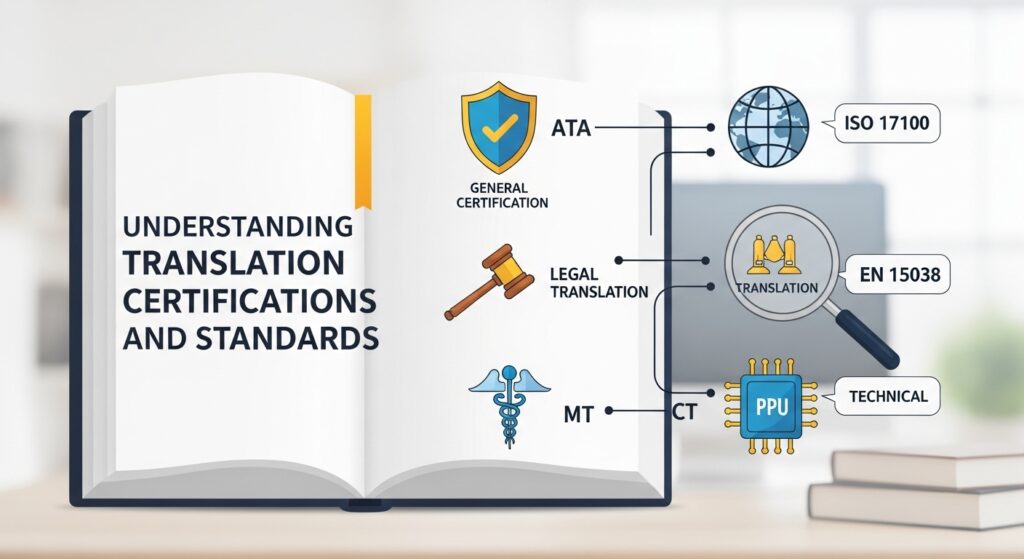
Government translation requires security clearances and specialized certifications, making understanding translation certifications and standards particularly complex in public sector contexts. Federal contractor translators must undergo background investigations and maintain active security clearances to work with classified or sensitive materials.
These professionals handle diplomatic communications, intelligence documents, and military technical manuals where accuracy and security are paramount.
Department of State certification requirements govern translators working with visa applications, passport documents, and consular services. These professionals must understand immigration law, consular procedures, and document authentication requirements. They work with birth certificates, marriage licenses, and educational transcripts where errors can affect people’s ability to travel, work, or study abroad.
Military translation standards follow Department of Defense guidelines for handling classified information and technical documentation. Certified defense translators must understand operational security requirements, weapons systems terminology, and tactical procedures. They work with training manuals, intelligence reports, and operational plans where accuracy affects mission success and personnel safety.
Court system certification varies by state and federal jurisdiction, with specific requirements for different types of legal proceedings. Certified court interpreters must demonstrate ability to interpret simultaneously, consecutively, and sight-translate documents under pressure. These professionals handle arraignments, depositions, and trials where accurate communication affects justice outcomes.
Industry-Specific Certifications: Understanding Translation Certifications and Standards by Sector
Different industries maintain unique certification requirements, making understanding translation certifications and standards sector-specific knowledge essential for choosing appropriate translation services. Energy sector translations require knowledge of environmental regulations, safety procedures, and technical specifications.
Certified energy translators work with environmental impact assessments, drilling permits, and safety protocols where accuracy affects regulatory approval and operational safety.
Educational translation certification requires understanding of academic standards, accreditation requirements, and transfer procedures. These professionals work with transcripts, diplomas, and course descriptions where accuracy affects students’ ability to continue their education or gain employment. Regional accreditation bodies maintain specific requirements for document translation and authentication.
Food and agriculture translation standards follow FDA, USDA, and international food safety requirements. Certified translators must understand HACCP procedures, nutritional labeling requirements, and organic certification standards. They work with product labels, safety procedures, and regulatory submissions where accuracy affects consumer health and product approval.
Entertainment industry translation requires understanding of copyright law, distribution agreements, and cultural adaptation principles. Certified translators work with contracts, scripts, and marketing materials where accuracy affects revenue distribution and legal compliance. Screen Actors Guild and other industry organizations maintain specific requirements for translation and localization services.
Verification Processes: Understanding Translation Certifications and Standards Authentication
Verifying translator credentials requires systematic approaches, making understanding translation certifications and standards authentication procedures essential for quality assurance. Professional association databases provide online verification of member status, certification levels, and disciplinary history. The ATA maintains a public database of certified translators with their language pairs and specialization areas.
Academic credential verification requires checking with issuing institutions and educational equivalency services. Many translators hold degrees from foreign universities, requiring evaluation by organizations like World Education Services (WES) or Educational Credential Evaluators (ECE). These services verify that foreign degrees meet equivalent standards in the target country.
Reference checking involves contacting previous clients and employers to verify translation quality, reliability, and professional conduct. Professional translators maintain portfolios of completed work and client testimonials that demonstrate their expertise in specific subject areas. Large projects often require multiple references from similar industries or document types.
Continuing education verification ensures translators maintain current knowledge of industry standards and technological developments. Professional associations require members to complete specific hours of approved training annually. Documentation of conference attendance, workshop completion, and certification renewals provides evidence of ongoing professional development.
Quality Assurance: Understanding Translation Certifications and Standards in Project Management
Quality assurance systems integrate certification requirements with project management procedures, making understanding translation certifications and standards essential for consistent service delivery. Translation memory systems maintain databases of previously translated segments, ensuring consistency across projects and reducing costs for repetitive content. These systems require trained operators who understand linguistic principles and quality metrics.
Revision procedures require qualified reviewers to check translations for accuracy, consistency, and adherence to client requirements. ISO 17100 mandates that revisions be performed by individuals other than the initial translator, ensuring independent quality assessment. Revision reports document changes made and rationale for corrections, providing clients with transparency about quality control processes.
Terminology management requires maintaining consistent translations for technical terms, brand names, and industry-specific vocabulary. Certified translators develop and maintain glossaries that ensure consistent usage across all project materials. These databases integrate with translation tools to provide real-time terminology validation during the translation process.
Client feedback integration requires systematic collection and analysis of quality assessments from project stakeholders. Rating systems, error tracking, and improvement recommendations help translation services maintain high standards and address recurring issues. Regular quality reviews with certified translators ensure continuous improvement and professional development.
Understanding translation certifications and standards represents far more than bureaucratic requirements – it’s about ensuring accuracy, reliability, and professional competence in situations where mistakes have serious consequences.
From court documents that affect legal outcomes to medical instructions that impact patient safety, certified translators provide the expertise and accountability that critical situations demand.
The certification landscape continues changing as technology advances and international business becomes more complex. New specializations emerge, standards get updated, and regulatory requirements evolve across different industries and countries. Staying current with these changes requires ongoing attention and professional commitment from both translators and the clients who depend on their services.
At Directline Translator, we maintain comprehensive certifications and stay current with changing standards because we understand what’s at stake. Your business success, legal compliance, and professional reputation depend on choosing translation services that meet the specific requirements of your industry and situation.
The investment in certified translation services pays dividends through avoided delays, prevented errors, and successful outcomes in critical situations.
The key to success lies in matching certification requirements with your specific needs. Take time to understand what certifications apply to your situation, verify translator credentials thoroughly, and work with services that maintain current certifications in your industry. Your future success depends on making informed decisions about translation quality and professional competence.
FAQs On Understanding Translation Certifications and Standards:
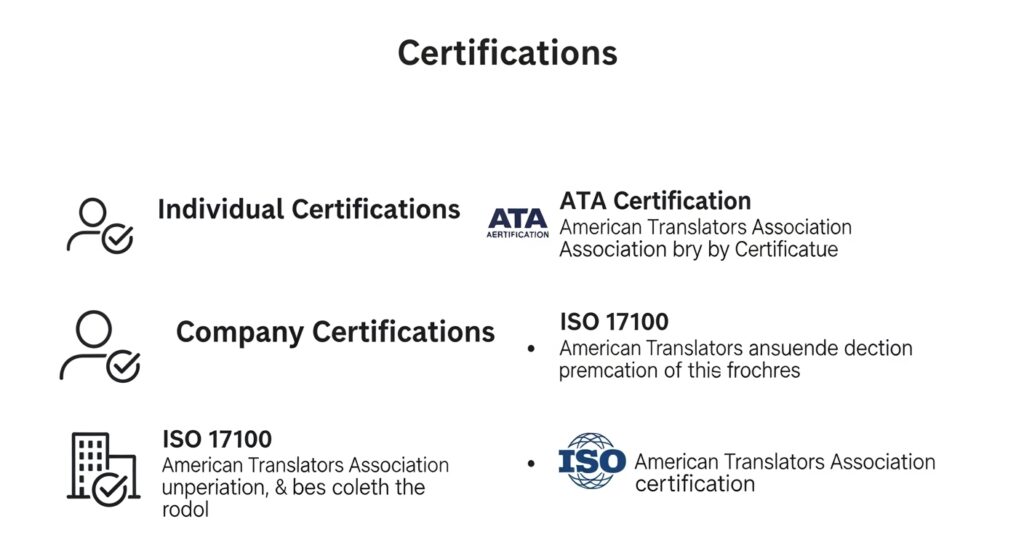
1. What’s the difference between certified and sworn translators? Certified translators have passed professional examinations and maintain association memberships. Sworn translators hold legal appointments from courts or government agencies, giving their translations official legal status. Sworn translations are required for court documents, while certified translations suffice for most business and personal needs.
2. How do I verify a translator’s certification status? Check professional association databases like ATA’s online directory. Contact the certifying organization directly to confirm current status. Request copies of certificates and verify education credentials through appropriate evaluation services. Ask for references from recent clients in similar industries.
3. Are online translation certifications legitimate? Some online programs offer legitimate continuing education, but be cautious of “instant certification” claims. Reputable certifications require rigorous testing, demonstrated experience, and ongoing education requirements. Always verify credentials through official association databases before hiring.
4. Which certifications do I need for immigration documents? Requirements vary by country and document type. USCIS accepts translations with certification statements from qualified translators. Some countries require sworn translators or official government authentication. Check specific requirements with the receiving agency before proceeding.
5. How much do certified translation services cost? Certified translations typically cost 20-50% more than standard translations due to additional qualifications and liability. Legal and medical translations command premium prices. Expect to pay $0.15-0.40 per word for certified services, with minimums of $50-150 per document.
6. Do all industries require certified translators? No, but many regulated industries strongly recommend or require certifications. Medical, legal, financial, and government sectors typically need certified translators. Marketing materials, general business communications, and personal documents may not require formal certification.
7. How long does translator certification take? Professional certification processes typically take 6-18 months including preparation, examination, and credential review. Some specializations require additional training and experience. Maintaining certification requires ongoing education and periodic renewal processes.
8. Can certified translators work in any language pair? Certifications are language-pair specific. A translator certified in English-Spanish may not be certified for English-French. Most professionals specialize in 1-3 language pairs where they can maintain the highest competency levels and stay current with terminology.
9. What happens if a certified translation contains errors? Certified translators carry professional liability insurance to cover errors. Clients can file complaints with professional associations, which may investigate and impose sanctions. Legal remedies may be available depending on the nature and consequences of errors.
10. How often do translation certifications need renewal? Most certifications require renewal every 2-3 years with continuing education requirements. Professional associations mandate specific hours of approved training, conference attendance, or examination updates. Some specializations require more frequent renewal due to rapidly changing regulations.