
 Elizabeth123
Accurate legal translation for wills in Nigeria is essential to preserve testators’ intentions amid linguistic diversity and complex inheritance laws. Errors in translating key terms can lead to disputes, especially with over 500 languages involved, including Yoruba, Igbo, and Hausa. Certified translators guarantee compliance with statutes like the Wills Act, addressing cultural nuances and avoiding invalidation. Professional services minimize risks, fostering smooth estate administration. Further details on steps, challenges, and case studies outline effective strategies for flawless execution.
Quick Summaries
- Professional translation services ensure accurate rendering of wills in Nigeria’s diverse languages, preventing legal disputes.
- Certified translators maintain fidelity to original intent and comply with Nigerian inheritance laws like the Wills Act.
- Translation Africa offers expertise in handling cultural nuances for wills in languages such as Yoruba, Igbo, and Hausa.
- Key steps involve thorough analysis of the document, precise terminology research, and adaptation for cultural contexts.
- Benefits include reduced litigation risks, enhanced trust among heirs, and efficient estate administration in Nigeria.
Importance of Accurate Will Translation in Nigeria
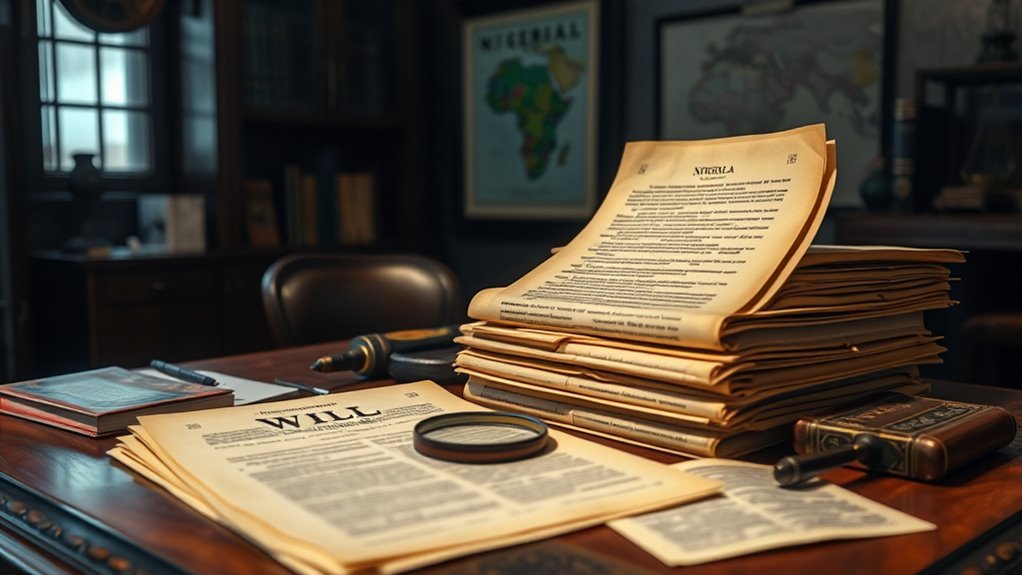
Accurate translation of wills in Nigeria is essential to uphold the testator’s intentions and prevent legal disputes. In a linguistically diverse nation, errors in translating key terms can distort asset distribution, leading to costly court battles and emotional strain on families. For instance, mistranslating phrases related to inheritance conditions may alter beneficiaries’ rights, undermining the document’s integrity. Professional translators, versed in legal nuances, guarantee fidelity to the original language, whether English, Yoruba, Igbo, or Hausa, hence preserving the testator’s directives. This precision not only aids executors in administering estates smoothly but also fosters trust among heirs, reducing the risk of prolonged litigation. Ultimately, accurate translation upholds justice and cultural sensitivity in will execution, safeguarding legacies from misinterpretation.
Overview of Nigerian Inheritance Laws

Nigerian inheritance laws form a multifaceted framework shaped by statutory provisions, customary practices, and Islamic principles, depending on the deceased’s ethnicity, religion, and domicile. Statutory laws, such as the Wills Act and Administration of Estates Law, primarily govern in southern states, emphasizing written wills and intestate succession rules. Customary laws, rooted in ethnic traditions like those of the Igbo or Yoruba, often prioritize family lineage and community allocations, though they must align with constitutional rights. For Muslims, especially in northern regions, Islamic inheritance follows Sharia, dividing estates based on Quranic guidelines that favor male heirs but guarantee female entitlements. These systems can intersect, requiring courts to determine applicable laws, which complicates estate administration and underscores the need for clear documentation to avoid disputes. Overall, this diversity promotes cultural sensitivity but demands careful navigation to uphold fairness and legality in asset distribution.
Steps for Translating Legal Documents

Translating legal documents for wills in Nigeria demands a structured approach to maintain integrity across cultural and legal contexts. First, translators must thoroughly analyze the original document, grasping its intent and key provisions under Nigerian law. They then research specialized terminology, guaranteeing accurate equivalents in the target language to avoid ambiguities. The translation process involves rendering text precisely, while adapting for cultural nuances without altering legal meaning. Subsequent steps include meticulous editing for clarity and accuracy, comparing the draft against the source to confirm fidelity. Finally, verify compliance with formatting standards specific to Nigerian wills, such as those from the Administration of Estates Law. This guarantees the translated document is reliable and enforceable, safeguarding the testator’s wishes.
Role of Certified Translators in Wills
Certified translators play a pivotal role in safeguarding the legal integrity of wills during translation, particularly in Nigeria. They possess specialized knowledge of legal terminology and cultural nuances, ensuring that translated documents accurately reflect the original intent. This expertise is essential for maintaining validity in a diverse linguistic landscape, where errors could compromise enforceability.
- Accurate Interpretation: Certified translators meticulously convert complex legal language, preserving precise meanings to avoid ambiguities.
- Adherence to Standards: They follow international and local regulations, providing translations that are admissible in Nigerian courts.
- Professional Certification: Their qualifications offer assurance of reliability, enhancing trust among beneficiaries and legal entities.
Ultimately, these professionals uphold the authenticity of wills, facilitating seamless cross-language estate planning.
Common Challenges in Will Translation
Translating wills in Nigeria presents several challenges that can affect accuracy and legal validity. Language barriers often complicate the precise conveyance of technical terms between languages. Cultural nuances further impact interpretations, potentially altering the original intent of the will.
Language Barriers
Language barriers frequently complicate the translation of wills in Nigeria, where the country’s linguistic diversity—spanning over 500 languages—poses significant challenges to accuracy and comprehension. Inaccurate translations can invalidate wills or lead to disputes, as subtle linguistic differences alter legal intent. For instance, terms may not have direct equivalents, risking misinterpretation.
- Ambiguities in terminology: Legal words often lack precise counterparts in other languages, causing confusion.
- Structural differences: Variations in sentence construction between languages can distort meaning and context.
- Translator qualifications: A shortage of experts fluent in both legal English and indigenous languages exacerbates errors.
Addressing these issues requires specialized training to guarantee fidelity and prevent costly legal pitfalls.
Cultural Nuances
Cultural nuances in Nigeria’s diverse society frequently complicate will translations, as differences in inheritance customs, family hierarchies, and traditional beliefs can alter intended meanings and spark legal conflicts. For instance, among the Yoruba, Hausa, or Igbo ethnic groups, communal land ownership may conflict with Western individual bequests, leading to disputes if not accurately conveyed. Translators must navigate religious influences, such as Islamic Sharia principles in the North versus Christian practices in the South, which dictate asset distribution. This requires expertise in both legal terminology and cultural contexts to prevent misinterpretations that could invalidate wills or cause familial rifts. Professional services like Translation Africa emphasize cultural training for translators, ensuring that subtle implications—such as the role of elders or gender-based inheritance rights—are preserved. Ultimately, overlooking these nuances risks not only legal invalidity but also social discord, underscoring the need for specialized, culturally informed translation in Nigeria’s multifaceted legal landscape.
Key Differences in International and Local Wills
The key differences between international and local wills in Nigeria center on international recognition and local requirements. International wills often require adherence to global standards for validity across borders, which can complicate their enforcement in Nigeria. Local wills, in contrast, must comply with specific Nigerian laws to guarantee they are enforceable within the country.
International Recognition
International wills in Nigeria often encounter distinct recognition challenges compared to local wills, primarily due to varying legal standards and international treaties like the Hague Convention. These challenges arise from the need to align foreign documents with Nigerian legal frameworks, which may require additional verification to guarantee validity and enforceability. For instance, international wills must navigate cross-border legal disparities, potentially leading to delays or disputes in probate processes.
- Hague Convention Compliance: International wills adhering to the Convention may face smoother recognition, but non-compliant ones often require extra authentication.
- Legal Conflicts: Differences in inheritance laws between countries can invalidate clauses that conflict with Nigerian customs or statutes.
- Authentication Requirements: Foreign wills typically need apostille or legalization, unlike local wills, which are processed domestically without such hurdles.
This underscores the importance of professional translation to bridge recognition gaps effectively.
Local Requirements
Local wills in Nigeria adhere to domestic legal standards that simplify processes compared to international ones. These standards, governed by the Wills Act 1837 as amended and Nigerian customary law, emphasize straightforward requirements like will capacity, proper witnessing, and registration with the Probate Registry. This contrasts with international wills, which must navigate cross-border legal complexities, such as Hague Convention compliance.
Key differences include jurisdictional scope, formalities, and enforcement ease, as outlined below:
| Aspect | Local Wills | International Wills |
|---|---|---|
| Governing Law | Nigerian statutes | Multiple jurisdictions |
| Formalities | Simple witnessing | Notarization required |
| Recognition | Domestic only | Global, with variations |
Understanding these distinctions guarantees effective estate planning in Nigeria, reducing potential disputes and streamlining inheritance.
Ensuring Compliance With Nigerian Regulations
Ensuring compliance with Nigerian regulations plays a vital role in the legal translation of wills, as it safeguards their enforceability and prevents potential disputes. Translators must navigate frameworks like the Wills Act and the Administration of Estates Law to guarantee accurate representation of intent, avoiding cultural or linguistic misinterpretations that could invalidate documents. This involves meticulous attention to legal nuances specific to Nigeria’s jurisdiction.
Key aspects of compliance include:
- Adhering to precise legal terminology to maintain the original document’s integrity.
- Verifying translations against Nigerian statutes to prevent conflicts with local customs.
- Obtaining necessary certifications from recognized authorities for authenticity.
Failure to comply can lead to court challenges, underscoring the need for rigorous processes in every translation step.
Benefits of Professional Translation Services
Professional translation services provide significant advantages in the legal translation of wills in Nigeria, particularly by leveraging expert knowledge to maintain accuracy and cultural fidelity. These services guarantee precise interpretation of complex legal terminology, reducing the risk of errors that could lead to disputes or invalidation under Nigerian law. They also incorporate cultural nuances, essential for wills involving diverse ethnic groups, thereby enhancing document integrity and enforceability.
| Benefit | Advantage |
|---|---|
| Accuracy | Minimizes misinterpretations |
| Cultural Sensitivity | Preserves local customs and norms |
| Legal Expertise | Guarantees compliance with statutes |
| Efficiency | Reduces processing time |
| Cost-Effectiveness | Avoids costly revisions |
Case Studies on Successful Will Translations
Examining real-world examples, case studies of successful will translations in Nigeria demonstrate how precise linguistic and cultural adaptations have resolved potential disputes and upheld will intentions in diverse legal scenarios. For instance, in a Lagos-based case, a will originally in English was translated into Yoruba, clarifying asset distribution and averting litigation. Similarly, in a northern scenario, Hausa translations addressed customary practices, ensuring seamless execution.
Key elements from these cases include:
- Cultural nuance integration: Translators adapted idioms to reflect local customs, preserving the testator’s wishes.
- Dispute prevention: Accurate wording minimized misinterpretations, fostering family harmony.
- Legal efficiency: Professional services expedited court processes, reducing delays and costs.
These examples highlight the transformative impact of expert translations in Nigerian contexts.
Essential Terms in Legal Will Translation
In the subtopic of essential terms in legal will translation, the focus shifts to key legal terms that form the foundation of accurate interpretations. Essential translation phrases also play a critical role in ensuring clarity and fidelity to the original intent in Nigerian contexts. Understanding these elements is crucial for effective cross-language conveyance in wills.
Key Legal Terms
Understanding key legal terms is essential for accurate translation of wills in Nigeria, as these terms guarantee the document’s intent and validity are preserved across languages. In Nigerian legal contexts, such terms form the backbone of estate planning and must be translated with precision to avoid disputes. Translators must navigate cultural and linguistic nuances to maintain the original meaning, guaranteeing compliance with laws like the Wills Act 1837 as amended.
Key terms often require careful handling:
- Testator: Refers to the individual creating the will; mistranslation could invalidate the document by altering intent.
- Beneficiary: Denotes the recipient of assets; accurate translation guarantees rightful inheritance without ambiguity.
- Executor: The appointed person to administer the estate; precise rendering prevents legal challenges in execution.
This focus on terminology upholds the will’s integrity in multilingual settings.
Essential Translation Phrases
Translators face critical phrases in legal will translation that demand precise handling to preserve intent and comply with Nigerian laws. In Nigeria, key phrases like “testator,” “beneficiary,” and “executor” must be rendered accurately to align with the Wills Act and customary inheritance rules. For example, conditional terms such as “in the event of” or “per stirpes” require careful adaptation to reflect local succession norms, avoiding ambiguities that could invalidate documents.
Idiomatic expressions, including “bequeath” or “last wishes,” demand equivalents that maintain legal validity while respecting cultural contexts. Translators must navigate differences between English common law phrases and Nigerian statutes, such as those under the Administration of Estates Law. Common challenges include mistranslating “residuary estate” or “joint tenancy,” which could lead to disputes.
To guarantee precision, professionals consult bilingual glossaries and legal experts, fostering translations that uphold the original intent and regulatory compliance. This meticulous approach minimizes risks in cross-cultural legal contexts.
Cultural Aspects of Translating Wills
While cultural nuances often shape the translation of wills in Nigeria, experts must consider local traditions, such as inheritance customs among ethnic groups, to maintain legal integrity and cultural sensitivity. In Nigeria’s diverse society, translators must navigate variations in family structures and communal land rights, ensuring that translated documents respect the original intent without cultural distortion. For instance, Yoruba and Igbo traditions emphasize lineage-based inheritance, which can conflict with Western legal norms, requiring careful adaptation.
Key cultural considerations include:
- The primacy of oral traditions in some ethnic groups, which may need documentation to align with written wills.
- Gender-specific inheritance rules, such as patrilineal systems in Hausa culture, to avoid misinterpretation.
- Communal property concepts, like those in Igbo societies, that influence asset distribution.
Selecting the Right Translation Provider for Wills
Choosing the right translation provider for wills in Nigeria requires evaluating key qualifications to guarantee accuracy and compliance. Providers must possess expertise in legal terminology and Nigerian inheritance laws, guaranteeing translations align with local customs and international standards. Certification from recognized bodies, such as the Chartered Institute of Linguists or equivalent, is essential to verify credibility. Experience in handling sensitive documents like wills helps mitigate risks of errors that could invalidate estates or lead to disputes. Clients should assess turnaround times, confidentiality protocols, and cost-effectiveness, opting for providers who use qualified native linguists fluent in English, Hausa, Yoruba, or Igbo. Thorough vetting, including client references and sample translations, guarantees the selected firm delivers precise, culturally sensitive results, safeguarding legal integrity in Nigeria’s diverse context. This process ultimately protects beneficiaries and upholds the testator’s intentions.
Frequently Asked Questions
How Much Does Will Translation Cost in Nigeria?
The cost of translating a will in Nigeria varies based on factors like document length, language pair, and service provider. Prices typically range from NGN 5,000 to NGN 50,000 or more, but exact fees depend on specific circumstances and should be verified.
What Is the Typical Timeline for Translating a Will?
The typical timeline for translating a will varies based on factors like document length, language complexity, and service efficiency. Simple wills often take 2-5 business days, while more complex ones may require 7-14 days for accurate completion.
Can Online Tools Replace Professional Translators?
In translation services, the question of whether online tools can replace professional translators is highly significant. These tools provide rapid results but often lack the precision and cultural insight that experts offer, limiting their effectiveness greatly.
Are There Free Options for Will Translation Services?
The question of free options for will translation services reveals that several online platforms provide basic free translations. However, for ensuring legal accuracy and validity, professional translators are advisable to prevent any misinterpretations and errors.
How Do I Correct Errors in a Translated Will?
Correcting errors in a translated will requires identifying inaccuracies first, then engaging a certified translator for revisions, and obtaining legal review to guarantee accuracy and compliance. Professional guidance helps maintain the document’s validity and prevents potential disputes.