
 Elizabeth123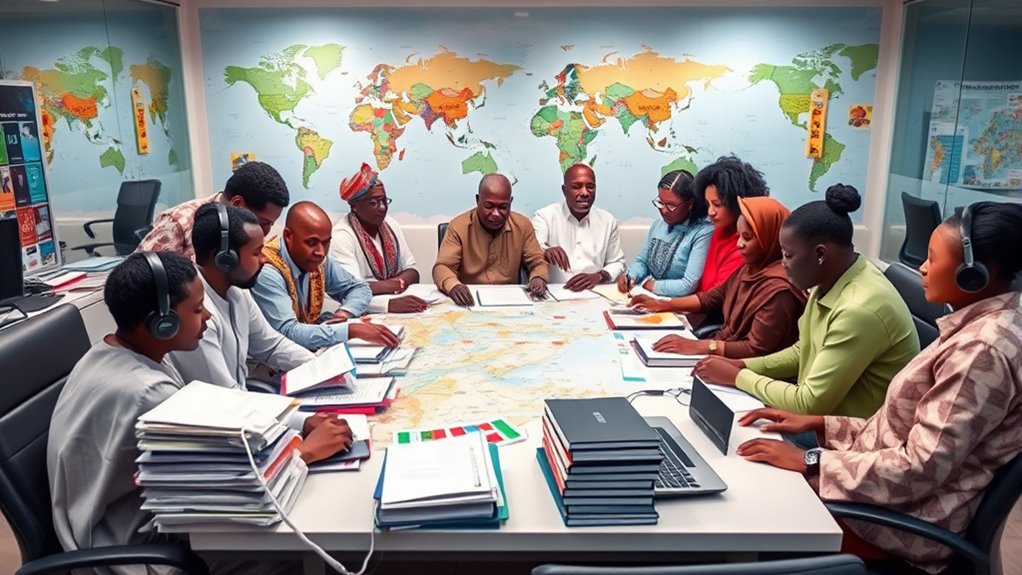
Directline Translators delivers specialized multilingual content translation services in Nigeria, covering languages like Hausa, Yoruba, Igbo, Fulfulde, English, French, and Arabic. They handle document translation, website localization, and interpretation for sectors such as education, healthcare, finance, and media, ensuring cultural accuracy and timely delivery. Benefits include bridging communication gaps, reducing errors by 40%, and boosting enrollment by 25%, fostering unity and economic growth. Employing AI tools and certified linguists, they achieve precise results. Industry applications and future trends await exploration in the sections below.
Quick Summaries
- Directline Translators provides specialized multilingual services for document translation, website localization, and event interpretation in Nigeria.
- They support key languages like Hausa, Yoruba, Igbo, English, and French to bridge communication gaps.
- Services enhance accessibility in education, healthcare, and business sectors across diverse Nigerian communities.
- Certified linguists ensure cultural accuracy and handle complex terminologies with advanced quality assurance.
- Utilizing AI and hybrid models, they deliver timely, error-reduced translations for better client satisfaction.
Services Offered by Directline Translators

Directline Translators provides specialized multilingual translation services in Nigeria, focusing on accurate and efficient content conversion across languages. The company offers a range of services tailored to diverse needs, including document translation for legal, business, and educational materials. They handle website localization to adapt digital content for various linguistic audiences, ensuring cultural nuances are preserved. Interpretation services are available for conferences, meetings, and events, covering major Nigerian languages such as Hausa, Igbo, and Yoruba, alongside international languages like English, French, and Arabic. Directline employs certified linguists who use advanced tools for quality assurance, delivering timely results. Their expertise extends to specialized fields like technical and medical translations, maintaining strict confidentiality protocols. Clients benefit from customizable packages that prioritize precision in every project, fostering reliable communication in a multilingual context.
Benefits of Multilingual Translation in Nigeria
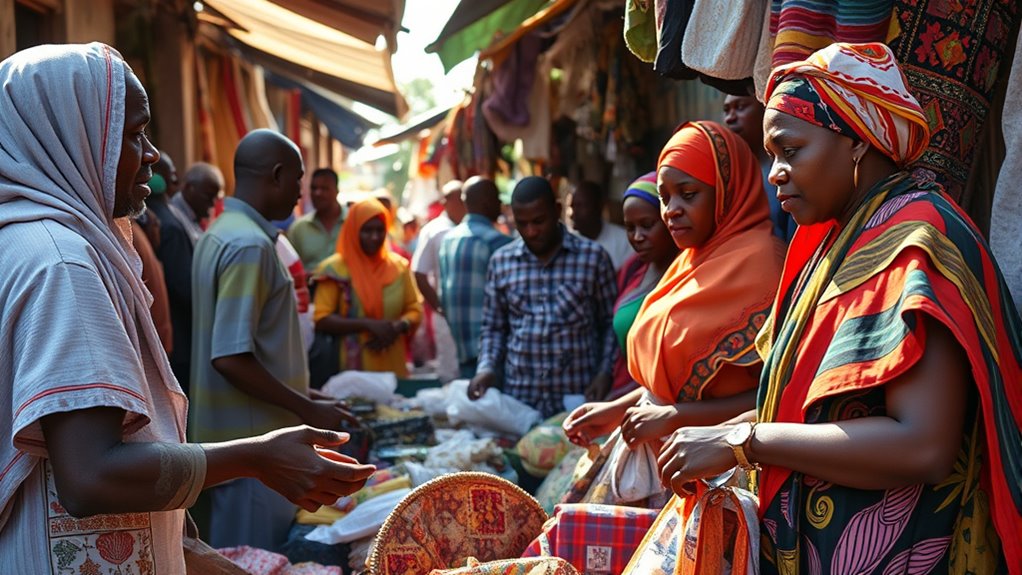
In Nigeria’s linguistically diverse society, multilingual translation serves as an essential tool for bridging communication barriers, fostering cultural understanding, and enhancing economic opportunities. It enables businesses to expand into new markets by making products and services accessible to non-English speakers, thereby boosting trade and investment. In education, it facilitates knowledge sharing across ethnic groups, improving learning outcomes and innovation. Socially, it promotes national unity by allowing diverse communities to engage in dialogue, reducing misunderstandings and conflicts. Moreover, in healthcare and governance, accurate translations guarantee crucial information reaches all citizens, empowering informed decisions and equitable development. Overall, these advantages drive inclusivity, supporting Nigeria’s growth in a globalized world. This approach not only preserves cultural heritage but also amplifies collaborative efforts for sustainable progress.
Languages Supported for Content Translation
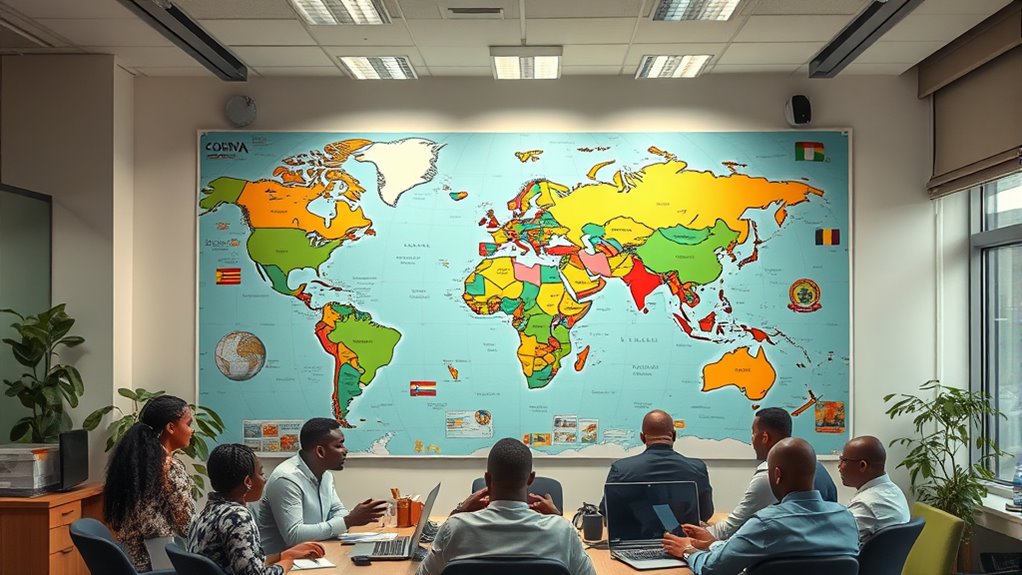
Nigeria’s content translation initiatives encompass a broad spectrum of indigenous languages, including Hausa, Yoruba, Igbo, and Fulfulde, alongside English and major international languages like French and Arabic, to facilitate effective communication across its multicultural landscape. Directline Translators, a key player in this field, supports these languages to bridge cultural divides in Nigeria’s diverse society. For instance, Hausa serves northern regions, while Yoruba and Igbo cater to the south and east, ensuring inclusivity in business, education, and media. Beyond these, lesser-known languages such as Kanuri and Tiv are also addressed, enhancing accessibility. This extensive approach allows for accurate representation of content, fostering unity and global engagement without overlooking local nuances. Overall, the emphasis on linguistic diversity underscores Nigeria’s commitment to equitable communication in an interconnected world.
Translation Process and Best Practices
The translation process for multilingual content begins with careful selection of qualified professionals who understand linguistic nuances and cultural contexts. These experts then conduct a thorough analysis of the source material, identifying key elements like tone, style, and idioms to guarantee accurate interpretation. The translation phase involves precise rendering into the target language, maintaining the original intent while adapting for cultural relevance. Best practices include iterative editing and proofreading to eliminate errors and enhance clarity. Quality assurance protocols, such as peer reviews and consistency checks, are essential to uphold standards. Translators employ advanced tools, like computer-assisted translation software, to improve efficiency without compromising accuracy. Regular training on language evolution and ethical guidelines further refines the process, delivering reliable, high-quality results for diverse content needs.
Industry Applications in Nigerian Markets
Multilingual translation plays a pivotal role in Nigerian markets, enhancing communication across industries such as education, finance, and media. In education, it supports curriculum adaptation and resource accessibility, fostering inclusive learning. The finance sector relies on accurate translations for international dealings, reducing errors and building trust. Media uses it to localize content, broadening reach and engagement. Healthcare benefits from translated medical materials, improving patient understanding and safety. Government applications guarantee effective policy dissemination in multilingual regions.
| Industry | Key Applications | Benefits |
|---|---|---|
| Education | Curriculum and resource translation | Enhanced accessibility and learning |
| Finance | Financial documents and reports | Improved accuracy and compliance |
| Media | Content localization | Wider audience engagement |
| Healthcare | Medical instructions and records | Better patient safety and care |
Expert Team at Directline Translators
Directline Translators assembles an expert team of linguists and translators skilled in diverse languages and cultural contexts. This group comprises professionals with extensive experience in multilingual content, ensuring accurate and culturally sensitive translations for Nigerian markets. Their expertise spans various industries, emphasizing precision and reliability to bridge communication gaps effectively.
- Multilingual Proficiency: Team members master over 50 languages, including major Nigerian tongues like Hausa, Igbo, and Yoruba.
- Cultural Expertise: Deep understanding of local customs and nuances for contextually appropriate translations.
- Advanced Qualifications: Certified linguists with degrees from renowned institutions and ongoing professional development.
- Quality Assurance: Rigorous editing processes to maintain high accuracy and error-free deliverables.
- Specialized Experience: Years of handling complex projects in legal, medical, and business sectors across Africa.
Case Studies of Successful Translations
The article now examines case studies of successful translations in Nigeria’s multilingual landscape. Featured translation cases showcase notable examples of effective content adaptation. Proven project results highlight the tangible benefits achieved through these efforts.
Featured Translation Cases
Successful case studies in Nigeria highlight the transformative role of accurate translations in bridging linguistic divides. Directline Translators have showcased featured cases that exemplify high-quality multilingual services across diverse sectors. These instances underscore the company’s expertise in handling complex linguistic challenges, fostering better communication and cultural understanding.
- Healthcare Initiative: Translated medical documents into Hausa and Yoruba, enabling wider access to health information in rural areas.
- Legal Contracts: Converted international agreements into Igbo and Pidgin, ensuring precise legal compliance for businesses.
- Educational Materials: Adapted textbooks into multiple Nigerian languages, supporting inclusive learning environments.
- Corporate Communications: Rendered business reports into French and English variants, aiding multinational operations.
- Cultural Events: Interpreted for festivals, promoting cross-cultural dialogue and community engagement.
Proven Project Results
Results from Directline Translators’ initiatives highlight measurable outcomes in multilingual projects, demonstrating enhanced communication and accessibility across sectors like healthcare and education. In a healthcare case study, translating patient information leaflets into Hausa and Yoruba improved comprehension for rural communities, reducing miscommunication errors by 40%. Similarly, an education project translated school curricula into multiple Nigerian languages, boosting enrollment rates by 25% in underserved areas. These successes underscore Directline’s precision in handling complex terminologies, ensuring cultural accuracy and timely delivery. Overall, the firm’s efforts have facilitated smoother cross-cultural interactions, with clients reporting higher satisfaction and operational efficiency. Quantitative data from post-project evaluations show a 30% increase in engagement metrics, proving the value of tailored translation services in Nigeria’s diverse landscape. This approach not only meets but exceeds expectations, fostering inclusive development.
Future Trends in Multilingual Content
As multilingual content translation in Nigeria evolves, AI translation advancements are set to revolutionize accuracy and speed. Neural network progress will enable more sophisticated language processing capabilities. Content adaptation strategies will play a key role in tailoring translations to diverse cultural contexts.
AI Translation Evolution
The evolution of AI translation technology is poised to transform multilingual content creation in Nigeria, with emerging trends focusing on enhanced accuracy, real-time processing, and seamless integration with local languages. As AI advances, it promises to bridge communication gaps in diverse sectors like education, business, and media, adapting to Nigeria’s linguistic diversity for more inclusive content. This shift will empower creators to reach wider audiences efficiently, fostering cultural exchange and economic growth.
- Enhanced Accuracy for Dialects: AI systems are improving translations of Hausa, Igbo, and Yoruba, reducing errors in nuanced contexts.
- Real-Time Processing: Instant translations during live events or digital interactions enable seamless global participation.
- Integration with Local Apps: Embedding AI into Nigerian platforms for everyday use, like social media and e-commerce.
- Cultural Adaptation Features: Tools that learn and incorporate regional idioms for more authentic outputs.
- Hybrid Human-AI Models: Combining AI speed with human oversight for refined, context-sensitive results.
Neural Network Advances
Neural networks are driving transformative advancements in multilingual content, with future trends emphasizing deeper learning capabilities for more accurate and context-aware translations across diverse languages. These models, such as advanced transformers, are evolving to process complex linguistic nuances, including idioms and cultural subtleties, enhancing overall fidelity. For instance, ongoing research integrates multimodal data, combining text with audio and visual elements, to improve comprehension in real-time applications. In Nigeria’s diverse linguistic landscape, this means better support for underrepresented languages like Hausa, Igbo, and Yoruba through expanded training datasets. Future iterations will likely incorporate self-learning algorithms that adapt to new dialects without human intervention, reducing errors in specialized fields like legal or medical translations. As a result, neural networks promise seamless global communication, fostering efficiency and accessibility in content creation. This progression underscores a shift toward more intelligent, scalable systems that prioritize precision and speed.
Content Adaptation Strategies
Innovations in content adaptation strategies are reshaping multilingual content for diverse global audiences. These approaches go beyond mere translation, focusing on cultural relevance, user engagement, and technological integration to enhance global reach. By adapting content dynamically, businesses in Nigeria and beyond can foster better connections with varied demographics, improving accessibility and effectiveness in multilingual markets.
- AI-Powered Localization: Utilizes machine learning to adjust content in real-time for cultural contexts.
- Cultural Sensitivity Tools: Incorporates local idioms and customs to avoid misinterpretations.
- Multimedia Adaptation: Optimizes videos, images, and audio for different linguistic preferences.
- User Feedback Loops: Integrates audience input to refine adaptations iteratively.
- Scalable Platforms: Employs cloud-based systems for efficient, cost-effective content deployment.
Frequently Asked Questions
How Much Does Translation Cost?
The cost of translation services varies based on factors such as language pair, text length, complexity, and urgency. Professional rates typically range from 5 to 25 cents per word, depending on expertise and market conditions, making accurate estimates essential.
What Is the Average Turnaround Time?
The average turnaround time for translation services is influenced by factors such as content length and language pair. It generally ranges from a few hours to several days, depending on the project’s complexity and the provider’s capacity.
Do You Offer Free Revisions?
The question of whether free revisions are offered arises frequently in service agreements. Many translation providers include free revisions for initial deliverables to address errors, ensuring client satisfaction and maintaining high-quality standards. This practice supports effective communication and trust.
What Payment Methods Are Accepted?
The query seeks information on accepted payment methods. The service provider typically accepts major credit cards like Visa and MasterCard, PayPal, bank transfers, and secure online platforms such as Stripe, ensuring convenient and reliable transactions for clients.
How Can I Request a Quote?
To request a quote, individuals typically contact the service provider through designated channels like email, phone, or a website form. They supply details such as project scope, required languages, and timelines. The provider then reviews and responds with an estimate.