
 directlineauthors
Walking through any major shopping district today, you’ll notice something fascinating: brands speak multiple languages on their storefronts, websites display content in dozens of different tongues, and customer service representatives switch between languages as naturally as breathing.
This transformation didn’t happen overnight. Retail translation has become the backbone of global commerce, allowing businesses to build meaningful relationships with customers across cultural and linguistic boundaries.
The numbers tell a compelling story. Companies that invest in proper retail translation see average revenue increases of 42% in international markets within the first two years. But this isn’t just about converting words from one language to another.
Smart retailers understand that effective translation bridges cultural gaps, builds trust, and creates shopping experiences that feel genuinely local to customers thousands of miles away from a company’s headquarters.
At Directline Translator, we’ve witnessed firsthand how the right translation approach can transform a struggling international expansion into a thriving global operation. We’ve seen small boutiques become international sensations and established brands completely revitalize their overseas presence through strategic translation initiatives.
The difference between success and failure often comes down to understanding that translation is not a one-size-fits-all solution.
What makes retail translation so different from other types of translation work? The answer lies in the unique challenges retailers face: seasonal campaigns that need simultaneous launches across continents, product descriptions that must appeal to diverse cultural preferences, and customer service interactions that require both linguistic accuracy and cultural sensitivity.
Each touchpoint in the customer journey presents its own translation puzzle, and solving these puzzles correctly can mean the difference between a customer who becomes a lifelong brand advocate and one who clicks away to a competitor.
This comprehensive guide will take you through every aspect of retail translation, from understanding the fundamental principles that drive successful international retail communication to implementing practical strategies that deliver measurable results.
You’ll learn about the latest technologies reshaping the translation landscape, discover how to avoid common pitfalls that derail even well-funded translation projects, and gain insights into emerging trends that will shape the future of global retail communication.
Understanding Retail Translation Fundamentals
Retail translation goes far beyond the mechanical process of converting text from one language to another. Think of it as cultural interpretation combined with marketing expertise, wrapped in linguistic precision.
When a customer in Tokyo reads a product description originally written in English, they should feel as though the content was created specifically for them, taking into account their cultural context, shopping habits, and communication preferences.
The foundation of effective retail translation rests on three pillars: accuracy, cultural relevance, and brand consistency. Accuracy ensures that product information, pricing, and legal disclaimers are correctly communicated.
Cultural relevance makes sure that marketing messages resonate with local audiences and don’t accidentally offend or confuse potential customers. Brand consistency maintains the company’s voice and personality across all languages, creating a cohesive global brand experience.
Consider how color preferences vary across cultures. While white symbolizes purity and cleanliness in Western markets, it represents mourning in some Asian cultures. A wedding dress retailer expanding into new markets needs translation services that understand these nuances and can adapt product descriptions accordingly. This level of cultural awareness separates professional retail translation services from basic translation tools.
The scope of retail translation extends to every customer touchpoint. Product catalogs, website content, mobile apps, customer service scripts, return policies, marketing emails, social media posts, and even packaging text all require careful translation. Each element contributes to the overall customer experience, and consistency across all these touchpoints builds trust and credibility.
Professional retail translators also understand the technical aspects of e-commerce platforms. They know how to work within character limits for product titles, understand SEO requirements for different search engines, and can adapt content for various device types and screen sizes. This technical knowledge ensures that translated content not only reads well but also functions properly within the retailer’s digital infrastructure.
Why Retail Translation Matters for Global Success
The global retail market is projected to reach $31 trillion by 2025, with cross-border e-commerce accounting for an increasingly large portion of this growth. Companies that ignore international markets leave enormous opportunities on the table. However, expanding globally without proper retail translation strategies often leads to expensive failures and damaged brand reputations.
Language barriers directly impact purchasing decisions. Research shows that 75% of consumers prefer to buy products with information in their native language, and 60% rarely or never buy from English-only websites.
These statistics become even more significant when you consider that English is the primary language for only about 5% of the world’s population. The math is simple: businesses that don’t translate their content miss out on 95% of potential global customers.
Trust plays a crucial role in online retail, and language significantly influences trust levels. When customers encounter poorly translated content, they question the company’s attention to detail and professionalism.
Conversely, high-quality translations that feel natural and culturally appropriate increase customer confidence and purchasing likelihood. This trust factor becomes even more important for higher-priced items or purchases from unfamiliar brands.
The competitive advantage of proper retail translation extends beyond immediate sales. Companies that invest in quality translation build stronger brand recognition in international markets, establish better relationships with local distributors and partners, and create positive word-of-mouth marketing that drives organic growth. These long-term benefits often outweigh the initial translation investment by significant margins.
Speed to market also depends heavily on translation capabilities. Retailers with established translation workflows can launch new products, seasonal campaigns, and promotional offers simultaneously across multiple markets. This synchronized approach maximizes the impact of marketing efforts and prevents competitors from gaining advantages in specific regions.
Key Challenges in Retail Translation Projects
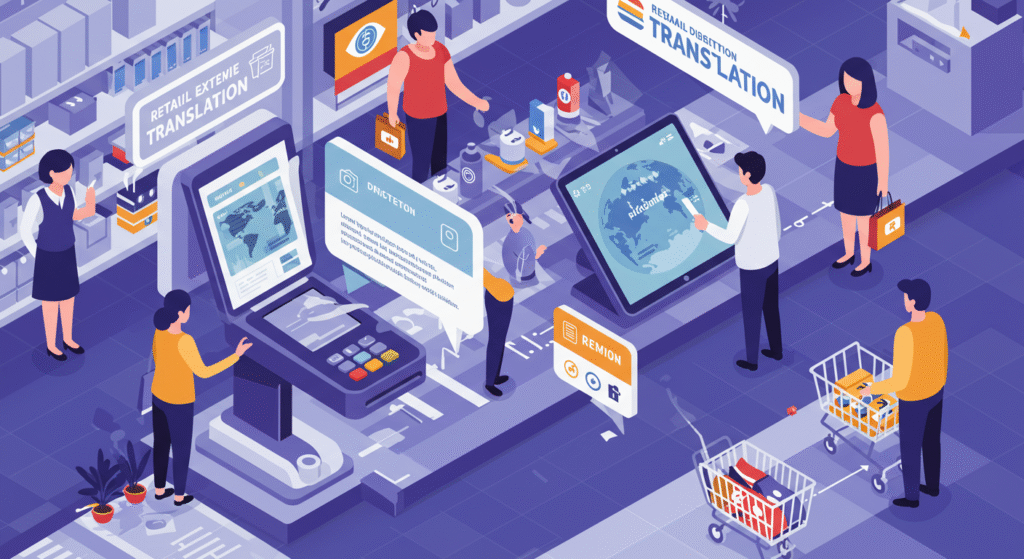
Retail translation projects face unique obstacles that don’t exist in other translation contexts. Volume and timeline pressures top the list of challenges. Retailers often need thousands of product descriptions translated within tight deadlines, especially during peak seasons like back-to-school or holiday shopping periods. Managing this volume while maintaining quality requires sophisticated project management and quality control systems.
Technical integration presents another significant challenge. Retail translations must work seamlessly with inventory management systems, e-commerce platforms, content management systems, and customer relationship management tools. A single formatting error or character encoding issue can break product pages or cause inventory discrepancies, highlighting the importance of technical expertise in retail translation teams.
Cultural adaptation goes beyond language translation and requires deep understanding of local markets. Product categories that perform well in one culture might be completely irrelevant in another. Fashion retailers, for example, must consider different body types, climate variations, cultural modesty standards, and style preferences when translating product descriptions and marketing materials.
Brand voice consistency across languages and cultures creates ongoing challenges. A brand that positions itself as friendly and casual in English might need to adopt a more formal tone in markets where casual communication is perceived as unprofessional. Maintaining brand personality while adapting to cultural expectations requires skilled translators who understand both linguistics and brand management.
Legal and regulatory compliance adds another layer of complexity to retail translation projects. Product warnings, ingredient lists, return policies, and terms of service must comply with local laws and regulations. Incorrect translations in these areas can lead to legal liability, regulatory fines, and customer safety issues. Professional retail translation services maintain expertise in various international legal requirements to ensure compliance.
Currency, measurement, and date format conversions seem simple but often cause problems when not handled systematically. A product listed as weighing “2.5 lbs” needs conversion to kilograms for most international markets, and prices must be displayed in local currencies with appropriate formatting. These details significantly impact user experience and purchasing decisions.
Essential Retail Translation Services and Solutions
Modern retail translation encompasses a wide range of specialized services designed to address the unique needs of retail businesses. Product catalog translation forms the foundation of most retail translation projects. This service goes beyond literal translation to include SEO optimization for local search engines, cultural adaptation of product names and descriptions, and technical formatting for various e-commerce platforms.
Website localization represents a comprehensive approach to adapting online retail presence for international markets. This service includes translating all website content, adapting navigation structures for different reading patterns, modifying layouts for languages that read right-to-left, and ensuring that all interactive elements function properly in multiple languages. Website localization also addresses technical SEO factors like hreflang tags and localized URL structures.
Mobile app translation has become increasingly important as mobile commerce continues to grow globally. App translation requires understanding of space constraints, user interface considerations, and app store optimization requirements. Professional retail translation services ensure that translated apps maintain functionality across different operating systems and device types while providing natural user experiences in each target language.
Customer service translation enables retailers to provide multilingual support across various channels. This service includes translating help documentation, FAQ sections, chat bot responses, and training materials for customer service representatives. Some providers also offer live interpretation services for phone and video customer support interactions.
Marketing campaign translation allows retailers to maintain consistent messaging across global marketing efforts. This service adapts promotional materials, email campaigns, social media content, and advertising copy for different cultural contexts while maintaining brand voice and marketing effectiveness. Professional marketing translation considers local advertising regulations, cultural sensitivities, and market-specific promotional strategies.
Legal document translation ensures that terms of service, privacy policies, return policies, and other legal content comply with local regulations and clearly communicate important information to customers. This specialized service requires translators with legal expertise in both source and target jurisdictions.
Implementing Effective Retail Translation Strategies
Successful retail translation implementation requires strategic planning that aligns with business objectives and market priorities. The first step involves conducting thorough market research to identify the most promising international markets based on factors like market size, competition levels, shipping logistics, and cultural fit with existing products or services.
Content prioritization helps retailers focus their translation efforts on materials that will have the greatest impact on customer acquisition and retention. High-priority items typically include core product lines, bestselling items, customer service essentials, and key marketing messages. Lower-priority content can be translated in later phases as international revenue grows.
Translation workflow establishment ensures consistent quality and efficient project management. Effective workflows include clear content submission processes, standardized translation briefs, quality assurance checkpoints, and approval mechanisms. Many successful retailers implement content management systems that integrate directly with translation services to streamline the process.
Quality control measures protect brand reputation and customer satisfaction. These measures include multiple review stages, native speaker testing, functionality testing on actual websites or apps, and customer feedback collection. Some retailers also implement A/B testing to compare different translation approaches and optimize for better performance.
Ongoing maintenance planning addresses the dynamic nature of retail content. Product descriptions change, new items are added, seasonal campaigns are launched, and customer service information is updated regularly. Successful retail translation strategies include provisions for continuous content updates and rapid turnaround times for urgent changes.
Cultural consultation adds valuable insights that pure translation cannot provide. Experienced retail translation providers offer cultural consulting services that help retailers understand local shopping behaviors, payment preferences, seasonal patterns, and marketing opportunities. This consultation can significantly improve the effectiveness of international expansion efforts.
Technology and Tools for Retail Translation
Modern retail translation relies heavily on technology to manage volume, maintain consistency, and ensure quality. Translation Memory (TM) systems store previously translated content segments and automatically suggest matches for similar content, improving consistency and reducing costs for repetitive content. Retail businesses benefit significantly from TM systems because product descriptions often contain similar elements across different items.
Computer-Assisted Translation (CAT) tools help human translators work more efficiently by providing automatic suggestions, terminology management, and quality assurance features. These tools are particularly valuable for retail translation because they help maintain consistency across large catalogs and enable faster turnaround times for seasonal campaigns.
Application Programming Interface (API) integrations allow retail translation to be embedded directly into content management systems and e-commerce platforms. These integrations enable automatic translation requests when new content is added, real-time status updates on translation progress, and seamless publication of translated content. API integrations significantly reduce the manual work required to manage ongoing translation needs.
Artificial Intelligence and Machine Translation technologies are rapidly improving and now provide useful starting points for retail translation projects. However, AI translations still require human review and editing to ensure cultural appropriateness and brand consistency. The most effective approach combines AI efficiency with human expertise to deliver high-quality results at reasonable costs.
Quality assurance tools help identify potential issues in translated content before it reaches customers. These tools can detect inconsistent terminology, formatting problems, broken links, and cultural red flags. Automated quality assurance enables large-scale retail translation projects to maintain high standards without proportionally increasing review time.
Cloud-based translation platforms provide centralized management for global retail translation projects. These platforms offer features like collaborative editing, automated workflow management, progress tracking, and integrated communication tools. Cloud platforms are particularly valuable for retailers with distributed teams or multiple international offices.
Building Strong Retail Translation Partnerships
Selecting the right retail translation partner significantly impacts the success of international expansion efforts. The ideal partner combines linguistic expertise with retail industry knowledge, understands e-commerce technical requirements, and can scale services to match business growth. Directline Translator specializes in retail translation and brings deep understanding of both language nuances and retail business challenges.
Partnership evaluation should consider factors beyond cost and turnaround time. Look for providers with proven experience in your product categories, expertise in your target markets, robust quality control processes, and technology capabilities that integrate with your existing systems. References from other retail clients provide valuable insights into a provider’s actual performance under real-world conditions.
Communication and project management capabilities often determine partnership success more than pure translation skills. Effective retail translation partnerships include dedicated project managers, clear communication protocols, regular progress updates, and responsive customer service. These operational factors become crucial when managing large-scale translation projects with tight deadlines.
Scalability planning ensures that translation partnerships can grow with business needs. Successful international expansion often leads to rapid increases in translation volume, additional target languages, and more complex project requirements. Partners should demonstrate ability to scale their services while maintaining quality and meeting deadlines.
Long-term relationship benefits include better understanding of brand voice and terminology preferences, improved efficiency through established workflows, preferential pricing for volume commitments, and priority handling during peak seasons. These benefits often justify slightly higher initial costs because they deliver better results and lower total cost of ownership over time.
Performance measurement and continuous improvement mechanisms help optimize translation partnerships over time. Regular performance reviews, customer feedback analysis, and market performance tracking provide data for improving translation strategies and partnership effectiveness.
Measuring ROI and Success in Retail Translation
Retail translation investments require careful measurement to justify costs and optimize strategies. Revenue attribution represents the most direct measurement approach, tracking sales increases in markets where translation efforts have been implemented. This measurement should account for factors like seasonality, marketing campaigns, and competitive changes to isolate translation impact.
Conversion rate improvements provide another key performance indicator for retail translation success. Comparing conversion rates before and after translation implementation helps quantify the impact of language accessibility on purchasing behavior. Segment analysis by language preference or geographic location provides additional insights into translation effectiveness.
Customer engagement metrics like time on site, pages per session, and bounce rates often improve significantly after implementing quality retail translation. These metrics indicate whether translated content successfully engages international customers and encourages them to explore product offerings more thoroughly.
Cost per acquisition analysis helps determine whether translation investments improve marketing efficiency in international markets. Effective retail translation often reduces customer acquisition costs by improving organic search rankings, increasing referral rates, and improving advertising performance in local languages.
Customer satisfaction and retention metrics provide longer-term indicators of translation success. Customer service inquiry volumes, return rates, and repeat purchase rates all reflect whether translated content effectively communicates product information and sets appropriate customer expectations.
Market share growth in international markets represents a comprehensive success metric that encompasses all aspects of translation effectiveness. Tracking market share changes over time provides insights into competitive positioning and long-term success of international expansion efforts.
Common Pitfalls and How to Avoid Them
Retail translation projects face several common pitfalls that can undermine success and waste significant resources. Machine translation overreliance tops the list of common mistakes. While AI translation tools continue improving, they still struggle with cultural nuances, brand voice consistency, and retail-specific terminology. Retailers who rely too heavily on machine translation often create customer experiences that feel impersonal and unprofessional.
Insufficient cultural research leads to translation choices that technically correct but culturally inappropriate. This problem commonly occurs when retailers focus solely on language conversion without considering local customs, preferences, and communication styles. Professional retail translation services include cultural consultation to avoid these issues.
Inadequate quality control processes allow errors to reach customers, potentially damaging brand reputation and customer trust. Common quality control failures include insufficient review stages, lack of native speaker testing, and failure to test translated content in actual customer environments. Comprehensive quality control requires multiple review stages and real-world testing.
Poor project management and communication create delays, increase costs, and reduce translation quality. Retail translation projects involve many stakeholders, tight deadlines, and complex technical requirements. Success requires clear communication protocols, realistic timeline planning, and experienced project management.
Inconsistent terminology and brand voice across different languages and markets confuse customers and weaken brand identity. This problem often occurs when multiple translation providers work on different aspects of retail content without proper coordination. Centralized terminology management and style guides help maintain consistency.
Inadequate technical integration causes functional problems that prevent customers from completing purchases or accessing important information. These issues range from character encoding problems that display garbled text to database integration failures that show incorrect pricing or availability information.
Future Trends in Retail Translation Technology
The retail translation landscape continues evolving rapidly, driven by advances in artificial intelligence, changing consumer expectations, and new technology platforms. Real-time translation capabilities are becoming increasingly sophisticated, enabling dynamic content translation that adapts immediately to customer language preferences. This technology will eventually allow retailers to personalize language experiences at the individual customer level.
Voice commerce translation represents an emerging frontier as smart speakers and voice assistants become more prevalent in retail interactions. Translating voice interactions requires different approaches than text translation, considering factors like pronunciation, cultural speech patterns, and conversational context. Retail translation services are developing specialized capabilities for voice commerce applications.
Augmented reality and virtual reality retail experiences create new translation challenges and opportunities. These immersive technologies require translation of spatial content, interactive elements, and contextual information that traditional translation approaches cannot address. Specialized AR/VR translation capabilities are emerging to support these new retail formats.
Artificial intelligence personalization will enable translation services to adapt content based on individual customer preferences, purchase history, and behavioral patterns. This personalized approach could improve customer engagement and conversion rates by delivering more relevant translated content to each customer.
Blockchain technology may impact retail translation by creating transparent, traceable translation workflows and enabling new compensation models for translators. Blockchain could also facilitate better collaboration between translation providers and improve quality assurance processes.
Automated quality assurance tools will become more sophisticated, using AI to detect cultural inappropriateness, brand voice inconsistencies, and functional problems in translated content. These tools will enable higher quality translation at scale while reducing human review requirements.
FAQs On Retail Translation: Connecting with Customers Worldwide:
Q: How long does retail translation typically take for a new market launch?
A: Timeline varies significantly based on content volume and complexity. A basic e-commerce site with 500 products typically requires 4-6 weeks for professional translation, while comprehensive market launches including marketing materials, customer service content, and legal documents often take 8-12 weeks. Rush services are available but may compromise quality or increase costs.
Q: What’s the difference between translation and localization for retail businesses?
A: Translation converts text from one language to another, while localization adapts content for specific cultural and market contexts. Retail localization includes currency conversion, measurement unit changes, cultural adaptation of images and colors, local compliance requirements, and payment method integration. Localization provides more comprehensive market preparation than translation alone.
Q: How much should retailers budget for professional translation services?
A: Professional retail translation typically costs $0.15-$0.35 per word depending on language combination, complexity, and volume. Most retailers budget 3-5% of international market revenue projections for translation and localization efforts. Initial market entry often requires higher investment, with ongoing maintenance representing lower percentages.
Q: Can machine translation be used effectively for retail content?
A: Machine translation can provide useful starting points for high-volume, low-risk content like basic product descriptions. However, customer-facing content, marketing materials, and legal information require human expertise to ensure cultural appropriateness and brand consistency. Hybrid approaches combining AI efficiency with human expertise often provide the best results.
Q: How do you maintain brand voice consistency across multiple languages?
A: Brand voice consistency requires comprehensive style guides, terminology databases, and experienced translators who understand brand personality. Regular training sessions, quality reviews, and feedback loops help maintain consistency. Working with specialized retail translation providers who understand branding challenges typically produces better results than managing multiple individual translators.
Q: What content should be prioritized when starting retail translation projects?
A: Priority should focus on content that directly impacts purchasing decisions: core product descriptions, pricing and shipping information, customer service essentials, and return policies. Marketing content and expanded product catalogs can be translated in later phases as international revenue grows and justifies additional investment.
Q: How do you handle seasonal campaigns and time-sensitive retail content?
A: Successful seasonal campaign translation requires advance planning, pre-established translation workflows, and priority scheduling with translation providers. Many retailers maintain translation calendars that align with marketing schedules and work with providers who offer expedited services for time-sensitive content.
Q: What technical considerations are important for retail translation projects?
A: Technical considerations include character encoding compatibility, database field length restrictions, SEO requirements for different search engines, mobile device compatibility, and integration with e-commerce platforms. Professional retail translation services understand these technical requirements and test translated content in actual customer environments.
Q: How do you measure the success of retail translation investments?
A: Success measurement includes revenue attribution, conversion rate improvements, customer engagement metrics, cost per acquisition analysis, and market share growth. Most retailers track multiple metrics to understand both immediate impact and long-term value of translation investments.
Q: Should retailers work with one translation provider or multiple specialists?
A: The choice depends on scale, complexity, and management preferences. Single providers offer better consistency, simpler project management, and often better pricing for volume commitments. Multiple providers might offer specialized expertise for different content types or markets but require more coordination effort. Most successful retailers eventually consolidate with one primary provider while maintaining backup relationships for specific needs.
Ready to expand your retail business globally with professional translation services? Directline Translator specializes in comprehensive retail translation solutions that help businesses connect authentically with customers worldwide. Our experienced team understands the unique challenges of retail translation and delivers results that drive international growth. Contact us today to discuss your global expansion goals and learn how our retail translation expertise can help you succeed in new markets.